Showing posts with label textile art. Show all posts

Thursday, December 27, 2018

Stitching Away

Two very quick progress reports today.  First, the sample of the Upcycle project:
Image and design copyright RPS

I simply took a piece of muslin and drew a portion of the trick or treat lettering in marker.  Then, made some hasty sketches of chickens and free motion quilted them on my little Elna model 50 "Grasshopper."  Then I began to go over the marker letters in chain stitches, at the same time auditioning two different weights of WonderFil Eleganza thread.  In all of the drawing classes I have had, my teachers always stressed the importance of drawing directly from the real thing, don't try to draw from memory.  These chickens are proof of that advice. 

I have dabbled a little bit with one of the little Mardi Gras series - the ones where I was supposed to finish one a week - here is some hand embroidery that I am pleased with:
Image and design copyright RPS

I am off to at least find pictures of chickens.  There is a barn full of chickens within sight of my house, but I don't know the neighbors well enough to ask them if I could hang out there for a while drawing their laying hens. 

Tuesday, December 25, 2018

Progress on the Upcycle entry

Finally, I am rolling along with something!  My entry for the SAQA Upcycle show is taking shape.  My first step was to cut the base fabric, and baste the large chicken feed sack pieces to it.  I also raw edge appliqued some small printed feed sack pieces to have a little color where the chicken feed bag pieces don't quite meet.
Image and design copyright RPS

Next, I played with the location for the secondary focal point pieces - chunks cut from a vintage printed tablecloth (check out the mid-century mod chickens) and a fun hanky with some more funky chickens on it.
Image and design copyright RPS

Once I had a good idea where the focal points will go, I started to place pieces of printed feed sack in the lower right corner.  The pieces will be raw edge appliqued, and I will use the same technique in the upper left corner.
Image and design copyright RPS

My next step is to make a small sample of the trick-or-treat part of the whole piece feed sack and try quilting it with thread sketched chickens.  I plan on outlining the trick-or-treat lettering in dark gray chain stitching.  Check back on Thursday to see how that goes.


Tuesday, September 25, 2018

World War I Challenge Progress

Sadly, I am missing the entry deadline for this quilt, it is still not finished.  I'm not upset by missing the deadline, I will still finish the quilt and since I am going to be a vendor at the show it was to be entered into, I will have it on display (and for sale) in my booth.  I have a few more things to add to it, but here are a couple of detail images of the quilting and the very cool stamens in the poppies (hand stitched - straight stitches with French knots).  Enjoy!

images and design copyright RPS

This week is quieter than last, so I really have every intention of posting on Thursday... will it be about the finish of this quilt, or something else?

Thursday, August 2, 2018

In One Hour

With peach and blackberry on my mind, as promised I allotted one hour to come up with a base for a fabric collage.  First, I made a very quick selection of fabrics and ironed them:


Next, I cut several sized of strips, and started sewing them together:

Moving on, I kept trimming where needed and sewing pieces to create not one, but two sections of pieced fabric, until they were big enough to be able to get 8 X 10" pieces out of them.


Here's the final result, two collage bases, each 8 1/2 X 10 1/2, in less than one hour. 
All images and designs copyright RPS

Yes, the size is small, but think about finishing things quickly.  If you are pressed for time, look for small projects.  You won't get overwhelmed, and your confidence will grow as you get satisfaction in finishing something in days or a week or two.

Next week, find out how I embellish the two pieces.  I honestly have no finished image in mind right now for these.  I am simply playing with a color palette.


Tuesday, May 15, 2018

Spring Cleaning, Spring Projects

It is vegetable garden season again, so for the next few weeks, I am going to go with one post a week here.  One thing is for certain, I am never bored!  In the midst of planting, I started some new sizes for my mini boxes, and I am once again working in color.  Here is a view of a whole pile of sides to be embellished:

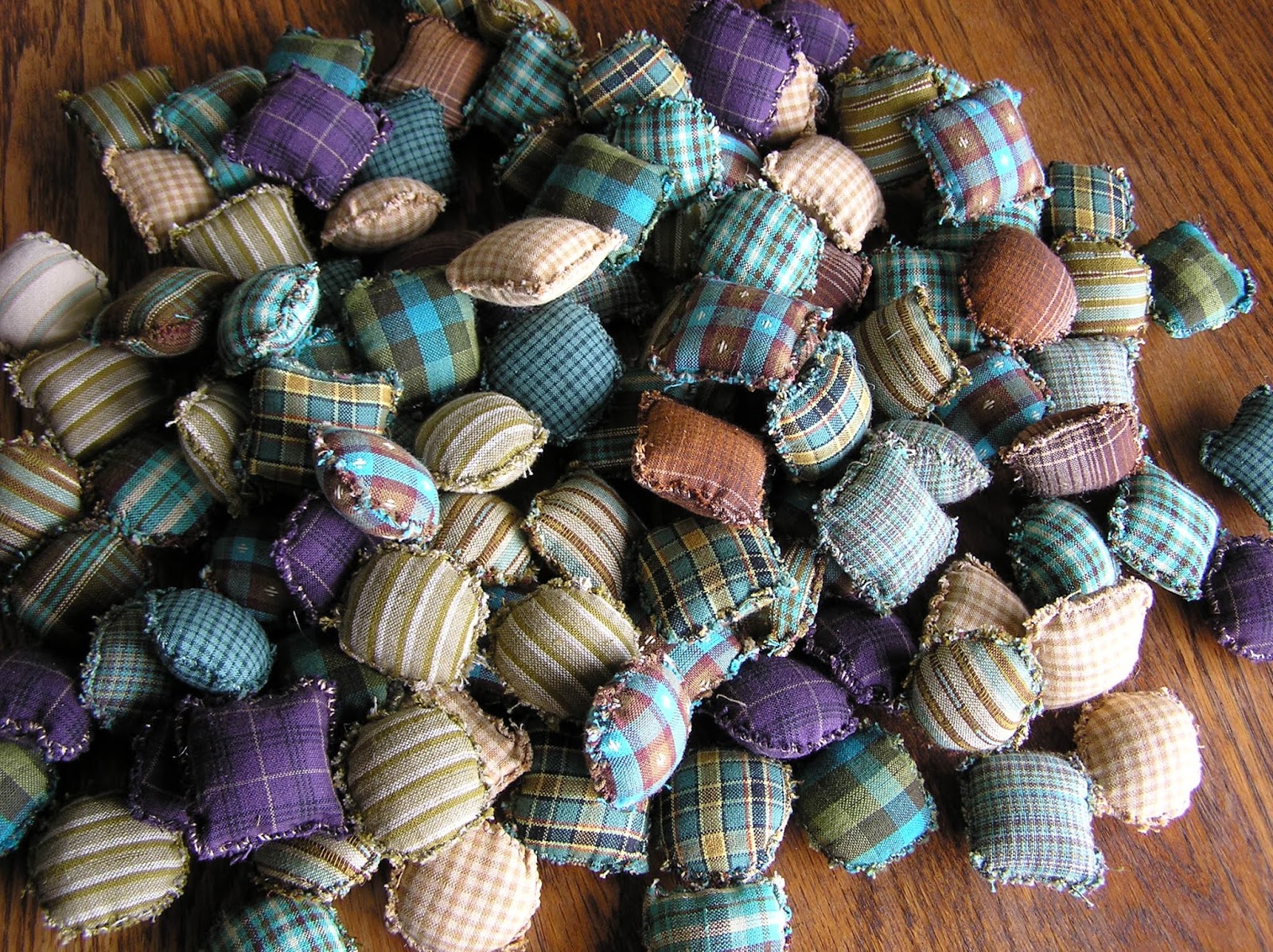
I have also been doing some spring cleaning, and I came across two zip bags full of 2" puffballs that I made a few years ago, with little idea of the final result.


The pastel ones are decorated with my early efforts in hand stitching.  About two years ago, I took some of the pastel puffballs lined them up in a shallow, open fabric box.  They looked like a surreal box of chocolate candies, a tribute to my days as a candy maker.  I'd like to create some other oddball fabric sculptures with these crazy puffballs.  To start, I think I will try putting a few in my mini boxes.  I need to decide if I should stitch them in the boxes, or just set them in there, to be removed and replaced.  I have no functional use in mind for the puffball stuffed boxes, just something fun to have around.  Well, they do have a purpose, to make their owner smile.  We all need things in our lives who sole purpose is to make us smile.

Thursday, April 19, 2018

Done!

It is finished:


Images and design copyright RPS

One of my many goals for this year is to finish more art work for competition, selling and project samples.  So, now that I have finished this box. I'm on to the next one!  I also want to finish a couple of 2-D collages that I started earlier this year, not to mention all the unfinished projects and series from the past few years... I'd better get busy!  Next week I will profile one of these older projects.

Thursday, April 12, 2018

Waiting until the Last Minute

A very short post, as I am attempting to make something to submit to a statewide all-media art exhibit.


I have to have all of these pieces embellished by Tuesday, so check back then to see how far I get.  This is in addition to vending at the Fredericktown Quilter's Market on Saturday!  I'd better get stitching....

Thursday, April 5, 2018

Give Up or Keep Going?

I had a set of four small (8 x 10") art quilts resurface in my mass of unfinished projects.  I started them over a year ago in an attempt to have some small impulse-buy type pieces to sell at art fairs.  They were cast aside as I wasn't happy with the way that I had assembled them. 
Image and designs copyright RPS

I had pillowcase bound these two after doing some, but not all of the intended embellishing.  I keep running into problems with embellishing before quilting through all three layers.  I don't always like putting a heavy quilting design on my work, as I want the fabric itself to be the focus.  I will quilt some pieces of fabric in these collages, and I'll add hand stitching in others, but I want some pieces of fabric left unadorned.  I'll sew along the seams to quilt, but here I've put thick trims in many places where I didn't want to quilt inside the fabric pieces.  It won't be a good idea to sew over the trims again in the quilting process.

Image and designs copyright RPS

The piece on the left in the above image has some hand stitching on it, and then I pillowcase bound it.  I should have added some trims along the seams before binding, so that the trims along the outer edged would have been neatly tucked in the binding seams.  The one on the right is just a pieced top with no quilting or embellishing yet.  I still have a chance to get it right on that one.

I am stuck on these small pieces, should I pitch the ones that I have embellished but could have assembled better?  How much time should I give to fixing them before giving up?  Finally, I 'm still uncertain as to how to combine all the different techniques that I want to use in a sequence that results in good craftsmanship.  I am going to think about this for another week, then I must decide to fix them or move on.

Thursday, March 15, 2018

Ideas and Inspiration


What was I thinking in my last post, promising to write about getting ideas?  For me, ideas for art pieces come from anywhere and everywhere.  If I lived to be 100 and sewed constantly until then, I still would not get out all the ideas that I have in my head.  For those of you looking for inspiration, it is a matter of training yourself to see and not just look.  Don’t overlook simple things, if you pass over many possible ideas, it is time to ask yourself whether or not you really want to make something.  Forget about the myth of waiting for inspiration, ideas are all around you. 

I might be captivated by a vintage textile.  My collages usually start with two or three vintage pieces that I like, and I build a composition around them.


A color combination could get me started:


I am surrounded by beautiful Appalachian meadows, forests and farmland, some of my art reflects the scenery I see every day.


Oddly, abandoned buildings hold great fascination for me.  My fabric boxes are my way of capturing the passage of time.  Those same boxes came about first from a quote in a John Steinbeck novel. 


Most importantly, just make things!  Make time to be creative at least several times a week.  Turn off the TV for an hour, and create.  Don’t be afraid of making a mistake, it will happen, but that is how we all learn.  I am always reciting my mantra that a new skill or technique will not be perfect the first time that you try it.  Keep going!

Friday, March 9, 2018

Getting Started with Art Quilts

A day late...

I'm often asked how to get started in art quilting.  There are many resources out there now for art quilting, not just books, but blogs (like this one!), workshops, retreats, online classes and more.  To me, the most important thing in an art quilt is that the finished piece is your own original design.  No patterns or kits, just your personal vision.  Too many people let themselves get intimidated by being original and creative.  Creating artwork in any media is no different than learning a language, playing a musical instrument, or any other skill.  Way back in our youth, we started to learn to read and write by first learning letters and their sounds.  The letters were put together in words, then sentences.  We learned grammar and punctuation, building to paragraphs.  Best-selling novels are not written by kindergartners!  Did you learn to sew in one hour? 

Two early projects that I made from The Art Quilt Workbook
Image and designs copyright RPS
Art has its own elements that need to be mastered a little at a time: color, design and composition.  Creativity can be learned or more appropriately, re-learned.  Too often , creativity is discouraged as we proceed in our education.  Yes, rules should be followed, but we also need to recognized when the rules must stick , and when we can stray from them. 

One of the exercises that I made from The Fiber Artist's Guide to Color and Design
Image and design copyright RPS

I have encountered three excellent books for anyone interested in art quilting and being more creative.  The first is Art Quilt Workbook by Jane Davila and Elin Waterston (C&T Publishing, 2007).  Another one is The Fiber Artist's Guide to Color and Design: The Basics and Beyond by Heather Thomas (Landauer Publishing, 2011).  One more is Art + Quilt by Lyric Kinard (Interweave Press, 2009).  All three do a great job of explaining the vocabulary of art design elements, and have a series of exercises to complete, highlighting the design concepts.  It is crucial to do the exercises - build your skill set.  Most importantly, make things!

Next time, a bit about getting ideas.

Tuesday, February 13, 2018

Collage with Vintage Textiles

I'll be giving a short demo each day of the upcoming Lebanon, Ohio quilt show on creating a unique fabric collage with vintage fabric and fancy pieces.

This is a finished collage, a very simple composition made from a fancy hankie, a hand dyed damask napkin, vintage ties and some pieces of my "scrap-lace" fabric technique.
Image and design copyright RPS

Over the next couple of weeks,  I will be working on a few more collages to showcase the items I sell at the quilt shows.  I'll post the progress here as they come together leading up to the show on the first weekend of March.  Here's the start I have on the two I will concentrating on:
Image and design copyright RPS

Check back Thursday to see my next steps on these.

Tuesday, February 6, 2018

Slow Progress

I have been making slow progress in keeping up my New Year's resolution to make more stuff.  One of my goals for some time has been to make various sizes of my fabric boxes.  A couple of years ago I made many 2 inch cube boxes and a few large ones in the range of 4X6X4" and 3X5X3."  Finally over the past week, I cut sides for 3 inch cubes and 2X3X2 boxes.  I have a lot of fun embellishing the box sides in a variety of surface design techniques.  When I start a run of new box sizes, I first make a bunch in a blend of neutrals - black, white, grays and tans.  Here are the sides for the new sizes, embellished and sorted, ready to start zigzagging together.


I've discussed in an early post about how my fascination with boxes came in part from John Steinbeck's dedication to his East of Eden.  Another source of inspiration for my boxes comes from abandoned buildings.  Yes, run down, crumbling old buildings.


My boxes are made up of fabric scraps from other projects, capturing the patched together look of some dilapidated houses.  As I stitch the sides of my smaller boxes together, the action of pinching the sides together causes the box to undergo some shifting and warping.  This is a good thing, it gives the box more character and adds to the visual interest of the piece.  Even the house that I live in, built in 1994, has parts that have swayed and shifted.  This is what I want to capture in my little boxes - the natural, slow process of physical aging of an inanimate structure.  Of course, all of us get bumps, sags and wrinkles as we age, so the inevitable wear that these boxes show over time simply reflects us as well.
Image and designs copyright RPS

My little fabric boxes are mostly decorative, but they could of course be used to hold, as Steinbeck put it, "whatever you have."

Thursday, January 4, 2018

More Alphabet Soup

I've been having fun with my stamp sets!  I started with light gray paint on my two vintage letter sets, as shown in my last post.  Then I added smaller letters from my stash of new rubber stamp letters in a sandstone paint, and a few letters in mauve:
Copyright RPS
Next, I added more letters in dark gray:
Copyright RPS
Finally, more tiny letters in black:
Copyright RPS

This is a great illustration of the design element of variety.  I have used variety of size and font in the letters and variety of value as well.  The variety here keeps the viewer's interest, it makes you look more at what is going on.  After a while, I fond myself trying to find words in the jumble of letters, even though I did not intentionally stamp any words.  Now to incorporate this piece of fabric into a collage...


Tuesday, January 2, 2018

Alphabet Soup

On December 21, I posted about vintage alphabet stamp sets, particularly one set that I was waiting to arrive that would hopefully replace an incomplete set.  Well, the set is not a match, it is nearly the same font, only larger!  Both sets are all capital letters, I wonder if there are lower case sets out there to go with them.  The new set will be great for larger art quilt projects, and I already like the idea of mixing fonts, even in a single word.  Maybe I will find a complete set of the smaller letters someday...

Anyway, I have been playing with the stamps, sponge brushing cheap acrylic paint on them.  Here you can see the two sizes of letters from the vintage sets:

I am going to keep going with my rubber stamp sets on this piece of muslin.  This will be another experiment with overlapping layers.  Check back on Thursday to see how the second layer went.

Tuesday, October 31, 2017

The Purple Collage, the Finale

Earlier this year, or maybe even last year, I periodically documented the creation of a fabric collage here.  It was finished for entry into the Mutton Hill Quilt Show, and here it is at the show:
Image and design copyright RPS

It was an experiment, not completely successful.  While I made it, I had in mind the paper collages of Kurt Schwitters (scroll down on the link for images of his work).  I think the influence of Schwitters is evident in my collage.  However, it is a bit of a wreck in the technique.  My most significant fault with my purple collage is the trial of sewing a slightly smaller quilt base, allowing the edges of the purple dyed damask napkin hang free.  I will not do that again!  It was hard to quilt near the edges, and I just don't like the floppy edges.  Additionally, the quilting made the whole thing lumpy!  The next collage that I make using a dyed napkin for a sub-base will have a slightly larger quilt base, not smaller.  I would like to try mounting future collages on canvas and stretcher bars, like a painting.  I have heard of other textile artists having good luck with that method, citing that would-be buyers relate to the treatment better. 

Another thing that I like about the collage is the seed stitching I did to create an unobtrusive border.  The stitching was necessary to try and secure the floppy edges, and it added more texture.  Not only is there paper sewn into this piece, but there really are pieces in there that would have been trash!  There are foil chocolate wrappers and plastic mesh produce bag pieces in the mix.  Look around as you go through your day with a vision to find unusual materials to stitch. 

Despite the problems, I really had fun making this and I still love it as a learning experience.  I will hang it somewhere in my house, as it is still a visual delight to me.  I hope to start my next collage this weekend.

Tuesday, October 24, 2017

Scrap Lace Fabric

I always draw a crowd when I demo my "scrap lace fabric" at quilt shows.  I had several request to re-post the instructions, so here they are.  These instructions are copyrighted, please do not re-post this elsewhere or distribute elsewhere.  


Here is something fun to make with strips of sheer fabric and funky yarns.  I came up with this after numerous utterances of “what do I do with this?” from shoppers in my quilt show/market booth.  I sell packages of assorted funky yarns, and many visitors to my booth love them, but get stumped on using them.  I also had to find a way to use a stash of beautiful vintage rayon scarves that were a surprise in a big box lot from a recent auction.  The technique is an expansion of thread lace from two sources: Fun with Sulky Blendables and Solid Color Cotton Threads, (Joyce Drexler/Sulky of America, 2011) and Fabric Embellishing: The Basics and Beyond (Ruth Chandler, Liz Kettle, Heather Thomas, Lauren Vleck, Landauer Publishing, 2009)
                                                                         
Supplies:                                          
2 pieces water soluble stabilizer (Sulky Solvy or Superior Threads Dissolve 4X), cut both pieces same size.
                HINT: Start small for the first try, about 10x10”
Assorted fancy yarns
Vintage scarf (rayon, polyester or silk)
Machine sewing thread to complement your color scheme

Here’s what you do:
1. Thread your sewing machine, set for free motion quilting
2. Cut narrow strips of scarf, roughly 1” wide, doesn’t have to be exact, vary the widths if desired
3. Place one piece of water soluble stabilizer on your work surface
Place strips of scarf on top of stabilizer, some horizontal, some vertical, some diagonal.  You don’t have to cover the entire surface, some gaps are OK.  You are creating a rough grid pattern.
4. Add random cuts of yarns on the strips; straight lines, curves lines, whatever looks good to you.
Add some more strips of scarf, but don’t completely cover the yarns you just used.
5. When you are happy with your arrangement of strips and yarns, place the second piece of stabilizer on top, matching it with the bottom piece. 
6. Carefully take the resulting “sandwich” to your sewing machine.  The fibers will shift as you sew, so watch for areas that are bunching and thin them out as you go.
7. Start quilting in a straight line pattern to “baste” the stabilizer sandwich, making your lines about 2”apart.
8. Once you get the basting lines done, you will now free motion quilt the entire sandwich.  Pick a quilting pattern that will allow you to easily double back over your design.  The first one of these that I made, I used the pebble design, and I simply stitched each pebble twice as I went.  The idea is to make sure the stitching is absolutely secure.  The quilting could take a while, since you are essentially quilting twice.  I also found that the stabilizer is difficult to maneuver at first, but it gets better as you go along.  I actually had to grab a fistful of one side of my sandwich to help it along.  Just be exceptionally careful that you don’t jerk it and break the needle.

9. When you are done quilting, you get to soak away the stabilizer.  Follow the instructions for the product you are using.  Let it dry, then you are ready to use it an embellishment, or attach to a piece of cotton and piece it into your next project.
COPYRIGHT 2017 RAGS PAPER STITCHES

Wednesday, May 24, 2017

Backsides (of quilts!)

I finally started quilting the purple collage that has been featured here periodically.  It was good to sit down at my little Elna "Grasshopper" again, but the long hiatus in sewing has resulted in a regression of my already meager free-motion quilting skills.  I'm not concerned about my skills on this one, as so far I am only outlining the major pieces of fabric.  The quilting isn't readily apparent, something that I like.  There are quilters out there who make some amazing designs with thread, but for my style of art quilting,that doesn't work.  I want my quilting to be structural, and not a feature of the overall design.

I'm not a fan of scrutinizing the backside of art quilts.  I understand the importance of having even stitches with balanced top and bottom thread tension, and the concept of good craftsmanship throughout a piece, but in art quilting, the maker often has different qualities that she wants to emphasize.  All the interest in my art quilts is on the front, the back is my place to anchor everything.  There is nothing great to see back there.


I suppose my feelings about the backsides of quilts comes from my very early days in acrylic painting.  Paintings of any type are usually framed, and the back of the piece is often covered in the framing process.  No one wants to see the backside of a painting.  This is a portion of the flip side of one of my high school efforts:


Nothing at all of interest to a viewer!  There is a reason why one side perpetually faces the wall, and so it goes with art quilts in my world.

Thursday, March 30, 2017

I Want to Learn...

This week has just slipped by me, with no progress in creative endeavors.  That means it is time for a top five list, just to get something on this blog!

Five embellishing techniques that I want to learn next:

1. Discharge "dyeing"
2. Foil transfer
3. Devore (Fiber Etch)
4. Thread Painting
5. Image transfers, other than printing directly on fabric through my inkjet printer.

Bluets in my lawn this week, yeah!

Tuesday, March 14, 2017

Return to the Purple Collage

No, I have not forgotten about the purple collage!
Image and design copyright RPS.  Please do not copy or repost

This is just another example of how art simply doesn't happen suddenly.  I had to set this piece aside for awhile to figure out how to proceed with it.  Since I'm not following a pattern or even conventional quilting techniques, I encounter frequent problems, especially many "what-do-I-do next" moments.  I still do not know if this piece will turn out OK in the end.  It is going through an "awkward teenager" phase now and  hope that it will look better with some more embellishing.

I think that I now need to attach the top, still unfinished, to a three layer quilt base that I have made, slightly smaller than the collage top, so that the edges of the collage extend beyond the base.  The base (below) is a lightly quilted and pillowcase bound piece made from plain Kona cotton and a piece of ice dyed flannel that didn't turn out well.  The flannel will be hidden once the collage is attached.
Image copyright RPS.  Please do not copy or repost

I am going to free motion quilt random loopy shapes in the negative spaces of the collage.  I am still pondering how to stitch the edges, since I cannot see where the base edges are if I am quilting the whole thing face up.  What have I gotten myself into?

In between this purple monster and a challenge project, I am working on some free motion quilting examples influenced by two more of my favorite children's book illustrators.  Check back in a couple of days for the results!

Thursday, January 12, 2017

That Purple Collage, Yet Again

If you get anything out of this ongoing series on this fabric collage, it is that art work usually does not happen overnight.  This is one factor in why good art is seemingly pricey.  This particular piece however, I'm not sure would fall into the category of good art, not yet, and maybe not ever!

I decided to add decorative stitching around the edges of the fabric pieces.  The first image below is a detail before I started the hand stitching, the next one is after.


The stitching adds a lot, doesn't it?  This pair of images is also a good illustration of how different lighting affects something.  The first image is in natural light, the second was taken with flash.

My next step is to join the collage to the three layer back, and quilt them together.  I am thinking ahead for once, and trying to decide how much more I should add to this collage.  I could add more fancy yarns:


How about more trim and some doilies?


I am going for a heavily textured creation, though I don't want to completely cover the lovely purple napkin that serves as the base.

Where will it end?  I don't know yet...