Showing posts with label free motion quilting. Show all posts

Thursday, December 27, 2018

Stitching Away

Two very quick progress reports today.  First, the sample of the Upcycle project:
Image and design copyright RPS

I simply took a piece of muslin and drew a portion of the trick or treat lettering in marker.  Then, made some hasty sketches of chickens and free motion quilted them on my little Elna model 50 "Grasshopper."  Then I began to go over the marker letters in chain stitches, at the same time auditioning two different weights of WonderFil Eleganza thread.  In all of the drawing classes I have had, my teachers always stressed the importance of drawing directly from the real thing, don't try to draw from memory.  These chickens are proof of that advice. 

I have dabbled a little bit with one of the little Mardi Gras series - the ones where I was supposed to finish one a week - here is some hand embroidery that I am pleased with:
Image and design copyright RPS

I am off to at least find pictures of chickens.  There is a barn full of chickens within sight of my house, but I don't know the neighbors well enough to ask them if I could hang out there for a while drawing their laying hens. 

Tuesday, September 25, 2018

World War I Challenge Progress

Sadly, I am missing the entry deadline for this quilt, it is still not finished.  I'm not upset by missing the deadline, I will still finish the quilt and since I am going to be a vendor at the show it was to be entered into, I will have it on display (and for sale) in my booth.  I have a few more things to add to it, but here are a couple of detail images of the quilting and the very cool stamens in the poppies (hand stitched - straight stitches with French knots).  Enjoy!

images and design copyright RPS

This week is quieter than last, so I really have every intention of posting on Thursday... will it be about the finish of this quilt, or something else?

Tuesday, August 28, 2018

Assorted Side Projects

Why, why, oh why did I buy a bushel of cucumbers at the produce auction?  Because I had no idea how many of the little green guys I would need for a batch of bread and butter pickles.  I've never made pickles before, but I really wanted to try this year.  The yield was at least 24 pints of bread and butters, and an unrecorded amount of dill spears - my mom took home a bunch of pints, so I don't know the exact figure. 

The moral of this story is: don't hold back, just jump in and do what you want to do!  The pickles are delicious, and I still have fresh cucumbers - lots of them.

I have set the 8 X 10" flower series aside for a few days, I have been working on a World War I commemorative piece for a challenge.  Here are two steps in the development of the 8 X 10" prototype for the final piece:
Image and design copyright RPS

Step one: a grave marker rubbing with a Shiva paint stick and free motion sewn "drawing" of poppies.
Image and design copyright RPS

Step two: color the poppies with crayon and Pentel Fabric Fun pastel dye sticks.  Hand stitching added to center of the poppy on the right.  One evening's work, that's all.  I'm off now to start the actual challenge piece.

Tuesday, October 24, 2017

Scrap Lace Fabric

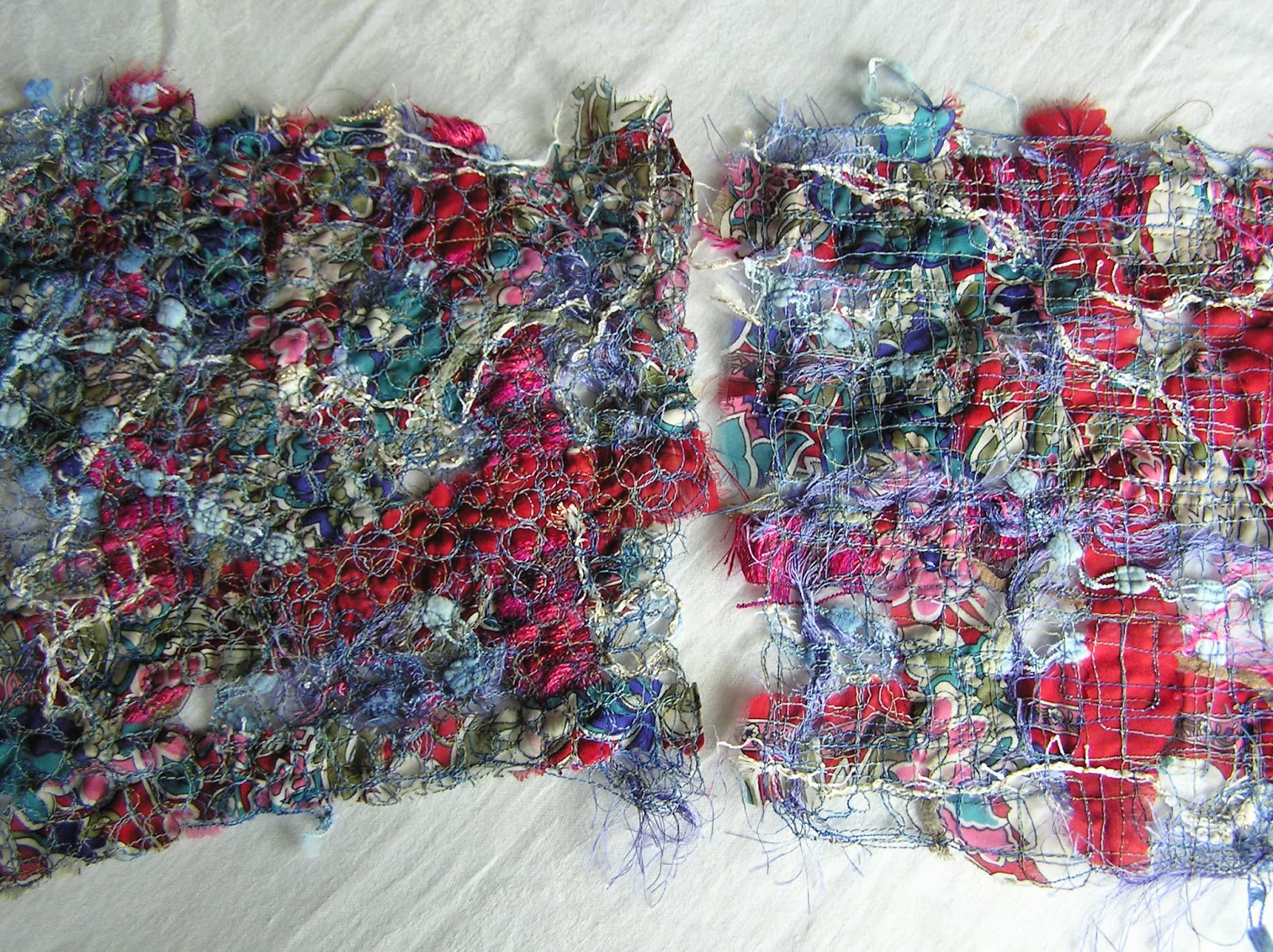
I always draw a crowd when I demo my "scrap lace fabric" at quilt shows.  I had several request to re-post the instructions, so here they are.  These instructions are copyrighted, please do not re-post this elsewhere or distribute elsewhere.  


Here is something fun to make with strips of sheer fabric and funky yarns.  I came up with this after numerous utterances of “what do I do with this?” from shoppers in my quilt show/market booth.  I sell packages of assorted funky yarns, and many visitors to my booth love them, but get stumped on using them.  I also had to find a way to use a stash of beautiful vintage rayon scarves that were a surprise in a big box lot from a recent auction.  The technique is an expansion of thread lace from two sources: Fun with Sulky Blendables and Solid Color Cotton Threads, (Joyce Drexler/Sulky of America, 2011) and Fabric Embellishing: The Basics and Beyond (Ruth Chandler, Liz Kettle, Heather Thomas, Lauren Vleck, Landauer Publishing, 2009)
                                                                         
Supplies:                                          
2 pieces water soluble stabilizer (Sulky Solvy or Superior Threads Dissolve 4X), cut both pieces same size.
                HINT: Start small for the first try, about 10x10”
Assorted fancy yarns
Vintage scarf (rayon, polyester or silk)
Machine sewing thread to complement your color scheme

Here’s what you do:
1. Thread your sewing machine, set for free motion quilting
2. Cut narrow strips of scarf, roughly 1” wide, doesn’t have to be exact, vary the widths if desired
3. Place one piece of water soluble stabilizer on your work surface
Place strips of scarf on top of stabilizer, some horizontal, some vertical, some diagonal.  You don’t have to cover the entire surface, some gaps are OK.  You are creating a rough grid pattern.
4. Add random cuts of yarns on the strips; straight lines, curves lines, whatever looks good to you.
Add some more strips of scarf, but don’t completely cover the yarns you just used.
5. When you are happy with your arrangement of strips and yarns, place the second piece of stabilizer on top, matching it with the bottom piece. 
6. Carefully take the resulting “sandwich” to your sewing machine.  The fibers will shift as you sew, so watch for areas that are bunching and thin them out as you go.
7. Start quilting in a straight line pattern to “baste” the stabilizer sandwich, making your lines about 2”apart.
8. Once you get the basting lines done, you will now free motion quilt the entire sandwich.  Pick a quilting pattern that will allow you to easily double back over your design.  The first one of these that I made, I used the pebble design, and I simply stitched each pebble twice as I went.  The idea is to make sure the stitching is absolutely secure.  The quilting could take a while, since you are essentially quilting twice.  I also found that the stabilizer is difficult to maneuver at first, but it gets better as you go along.  I actually had to grab a fistful of one side of my sandwich to help it along.  Just be exceptionally careful that you don’t jerk it and break the needle.

9. When you are done quilting, you get to soak away the stabilizer.  Follow the instructions for the product you are using.  Let it dry, then you are ready to use it an embellishment, or attach to a piece of cotton and piece it into your next project.
COPYRIGHT 2017 RAGS PAPER STITCHES

Wednesday, May 24, 2017

Backsides (of quilts!)

I finally started quilting the purple collage that has been featured here periodically.  It was good to sit down at my little Elna "Grasshopper" again, but the long hiatus in sewing has resulted in a regression of my already meager free-motion quilting skills.  I'm not concerned about my skills on this one, as so far I am only outlining the major pieces of fabric.  The quilting isn't readily apparent, something that I like.  There are quilters out there who make some amazing designs with thread, but for my style of art quilting,that doesn't work.  I want my quilting to be structural, and not a feature of the overall design.

I'm not a fan of scrutinizing the backside of art quilts.  I understand the importance of having even stitches with balanced top and bottom thread tension, and the concept of good craftsmanship throughout a piece, but in art quilting, the maker often has different qualities that she wants to emphasize.  All the interest in my art quilts is on the front, the back is my place to anchor everything.  There is nothing great to see back there.


I suppose my feelings about the backsides of quilts comes from my very early days in acrylic painting.  Paintings of any type are usually framed, and the back of the piece is often covered in the framing process.  No one wants to see the backside of a painting.  This is a portion of the flip side of one of my high school efforts:


Nothing at all of interest to a viewer!  There is a reason why one side perpetually faces the wall, and so it goes with art quilts in my world.

Saturday, March 18, 2017

Children's Book Illustrators, Again

One of my all-time favorite books as a youngster was Anno’s Journey by Mitsumasa Anno (original U.S. edition, William Collins Publishers, 1978).  As much as I loved to read from an early age, Anno’s Journey has no text, only ink and watercolor landscapes that trace a traveler’s path across Europe of an undetermined historic time.  Anno’s drawings consist of very simple ink outlines, augmented by watercolor wash.  (Take a look at examples here and here.)  They are simple and complex all at the same time.  His buildings are a delight of textures, while his people and animals are outlines unencumbered by shading for depth.  There really isn’t room for too much detail in his figures, as they are very small in his vast land and cityscapes.  The color in his illustrations is typically understated –mostly muted tones.

Image copyright RPS. Please do not copy or repost
My first attempt at a free motion drawing inspired by Anno.

As a child, I missed Anno’s Flea Market (first U.S. edition Philomel Books, 1984), but I have been studying a copy of it, and I think I love it more than the Journey.  Another wordless tale, this flea market unfolds over the pages, set within the walls of a medieval fort/city/castle.  The place and time that this flea market takes place is ambiguous, and the ages of the items don’t give any clues, nor does the dress of the people in the market.  What I find most fascinating in Anno’s drawings of the flea market is the way he ignores perspective and scale to show the viewer all that is happening.  The vendors’ table tops are tilted to nearly vertical so that Anno’s economical line drawings of the items may be viewed.  The items themselves are drawn out of scale; hand tools as tall as the people, garlic bulbs as big as the figures’ heads, and so on.  The skewed scale and perspective really doesn’t matter here, as there is so much going on in his story illustrations.  Here and there, you will find somewhat sinister things going on at this flea market – a man with a trumpet on his head, an artist painting a busty rendition of a flat chested model, and Kermit the Frog makes an unexpected appearance! 

Image copyright RPS. Please do not copy or repost
The same quilted piece from above, with colored pencil added. 
Next time, I would add a stabilizer under the top fabric. 
Colored pencil does not adhere well to stretchy fabric.


What I take as an art quilter from Anno is his use of line, his mastery of storytelling without words, and his inclusion of unexpected surprises.  After looking at these two books, some free motion quilting exercises came to mind.  First, try “drawing” outlines of everyday objects by free motioning.  This is a great way to improve you hand-eye coordination.  Next, try creating a simple line landscape with a building in it.  How can you add texture to the land and structure with stitching?  Finally, what little details could you add to your art that would surprise the viewer?  What can you add that would make the viewer look longer at the piece?  

Tuesday, March 14, 2017

Return to the Purple Collage

No, I have not forgotten about the purple collage!
Image and design copyright RPS.  Please do not copy or repost

This is just another example of how art simply doesn't happen suddenly.  I had to set this piece aside for awhile to figure out how to proceed with it.  Since I'm not following a pattern or even conventional quilting techniques, I encounter frequent problems, especially many "what-do-I-do next" moments.  I still do not know if this piece will turn out OK in the end.  It is going through an "awkward teenager" phase now and  hope that it will look better with some more embellishing.

I think that I now need to attach the top, still unfinished, to a three layer quilt base that I have made, slightly smaller than the collage top, so that the edges of the collage extend beyond the base.  The base (below) is a lightly quilted and pillowcase bound piece made from plain Kona cotton and a piece of ice dyed flannel that didn't turn out well.  The flannel will be hidden once the collage is attached.
Image copyright RPS.  Please do not copy or repost

I am going to free motion quilt random loopy shapes in the negative spaces of the collage.  I am still pondering how to stitch the edges, since I cannot see where the base edges are if I am quilting the whole thing face up.  What have I gotten myself into?

In between this purple monster and a challenge project, I am working on some free motion quilting examples influenced by two more of my favorite children's book illustrators.  Check back in a couple of days for the results!

Tuesday, September 13, 2016

Quilting ideas

The actual process of quilting my textile art pieces always gives me trouble.  I'm bored with the usual quilting motifs; most of them just don't work well with my ragged edge collage technique.  I must quilt these creations, the stitching holds the layers together and it is mandatory to enter them in shows, the stitching through layers of fabric is the total identity of "quilt."  The quilt stitching is also a vital design element in the whole piece.

I'm not proposing any solid answers here to my own dilemma; I guess I am just ranting today.  I have some ideas that I am soon to attempt.  Recently, I found these line drawings while doing research on something else:
This page is from the October, 1887 Criterion magazine, located at the Marietta College Library.  I believe that it was part of an order form for embroidery patterns, but I am wondering if I could use the idea of line drawing and turn that into quilting designs.  The concept probably still won't work with most of my collages, but I could easily come up with another overall design concept to feature the line drawing-quilting.  Maybe I'll just use much bigger collage pieces.  Creativity is all about rethinking what you have done and figuring out how to do what you want to do.


Thursday, April 21, 2016

More Fabric Flowers

I have been chipping away this week at various nearly-finished projects.  One of the projects has been a sample for a future class that I want to teach.  Part of the sample includes making dimensional flowers with Tyvek (the woven plastic house wrap stuff) and fabric.  The process of working with Tyvek is detailed in Fabric Embellishing: The Basics and Beyond (Ruth Chandler, Liz Kettle, Heather Thomas, Lauren Vleck, Landauer Publishing, 2009).  I'm not going to quote the entire process here, but here is one thing to do with the Tyvek - spring flowers!

It seems like every creative project has to go though on ugly stage, even this quick, simple flowers.  Here they are, cut out after free motion quilting:


Not very exciting at this point.  But, after heating the fabric and Tyvek "sandwiches," they turn into this:


Much more interesting, no?  I still have to add beads to the centers.  Some of my flowers looked horrible before the heat treatment, but the puckering hides a lot of problems.  There were a few flowers that I thought would be fine, but did not turn out well in the end, sometimes it is best not to try and predict the outcome, but keep on making and see what happens.


Tuesday, December 1, 2015

Fun project: "Lace" from funky yarn and fabric strips


Here is something fun to make with strips of sheer fabric and funky yarns.  I came up with this after numerous utterances of “what do I do with this?” from shoppers in my quilt show/market booth.  I sell packages of assorted funky yarns, and many visitors to my booth love them, but get stumped on using them.  I also had to find a way to use a stash of beautiful vintage rayon scarves that were a surprise in a big box lot from a recent auction.  The technique is an expansion of thread lace from two sources: Fun with Sulky Blendables and Solid Color Cotton Threads, (Joyce Drexler/Sulky of America, 2011) and Fabric Embellishing: The Basics and Beyond (Ruth Chandler, Liz Kettle, Heather Thomas, Lauren Vleck, Landauer Publishing, 2009)


Supplies:

2 pieces water soluble stabilizer (Sulky Solvy or Superior Threads Dissolve 4X), cut both pieces same size.

                HINT: Start small for the first try, about 10x10”

Assorted fancy yarns

Vintage scarf (rayon, polyester or silk)

Machine sewing thread to complement your color scheme


Here’s what you do:

1. Thread your sewing machine, set for free motion quilting

2. Cut narrow strips of scarf, roughly 1” wide, doesn’t have to be exact, vary the widths if desired

3. Place one piece of water soluble stabilizer on your work surface

Place strips of scarf on top of stabilizer, some horizontal, some vertical, some diagonal.  You don’t have to cover the entire surface, some gaps are OK.  You are creating a rough grid pattern.

4. Add random cuts of yarns on the strips; straight lines, curves lines, whatever looks good to you.

Add some more strips of scarf, but don’t completely cover the yarns you just used.
 

5. When you are happy with your arrangement of strips and yarns, place the second piece of stabilizer on top, matching it with the bottom piece. 

6. Carefully take the resulting “sandwich” to your sewing machine.  The fibers will shift as you sew, so watch for areas that are bunching and thin them out as you go.

7. Start quilting in a straight line pattern to “baste” the stabilizer sandwich, making your lines about 2”apart.

8. Once you get the basting lines done, you will now free motion quilt the entire sandwich.  Pick a quilting pattern that will allow you to easily double back over your design.  The first one of these that I made, I used the pebble design, and I simply stitched each pebble twice as I went.  The idea is to make sure the stitching is absolutely secure.  The quilting could take a while, since you are essentially quilting twice.  I also found that the stabilizer is difficult to maneuver at first, but it gets better as you go along.  I actually had to grab a fistful of one side of my sandwich to help it along.  Just be exceptionally careful that you don’t jerk it and break the needle.

9. When you are done quilting, you get to soak away the stabilizer.  Follow the instructions for the product you are using.  Let it dry, then you are ready to use it an embellishment, or attach to a piece of cotton and piece it into your next project.