A short post today, as I have killed a lot of time this afternoon looking for more vintage pin looms online and exploring a nicely done site about them, Eloomanation.
The book I mentioned in my last post is Pin Loom Weaving by Margaret Stump (Stackpole Books, 2014). Most of the pin loom projects out there are a little too... dull (for lack of a softer term) for me, too much in the kitschy craft realm. Of course, I don't like knitted sweaters, so I guess I come into this with a bias. I want to twist these little pin loom squares into something unusual and unexpected. I'm working on making some flowers with them to go with a larger project in the works. Speaking of that project, I really should get back to work on it. Next time, the start of an extensive series on who and what has influenced my art ideas.
Thursday, March 24, 2016

Tuesday, March 22, 2016
Pinning Down Pin Looms
Last week, I had to make a seven hour round trip in one day to pick up three pieces of my artwork, not exactly something I was all that happy about. It is a trip I make on occasion, but I usually make the trip a several day visit, not just for business, but for friends as well. There is an antiques mall at the halfway point between the two points that made my journey. It is a perfect time to get out and stretch, and hopefully find something for my varied collections. On my journey last week, halfway down the first row of showcases, I find this:

A set of vintage Weave-It pin looms! One four inch square and one two inch square, in the original box, with the original needles. No instructions, but I have a modern Zoom Loom that is nearly identical in design. This little treasure made the long day worth while. I certainly don't need anymore distractions from the various half finished projects that I have going, but I have of course been playing with my new "toys."

I had no problems using the Zoom Loom instructions on the vintage looms. The two small squares in the upper left corner were done with Valdani #8 cotton, the rest with assorted fancy yarns. Somewhere, I have a book on pin loom weaving, I need to find it. More on that next time...
Thursday, March 17, 2016
Horses, farming and quilts
I had a short trip back home last week, more to take an art
quilting class than to visit. The trip
ended up being an interesting illustration of the six degrees of separation
theory, and tied together some significant interests in my life.
The class was held at Lake Farm Park, an educational working
farm, but forty years ago, the land was Locust Farms, home to a nationally
renowned Arabian horse breeding and training facility. In the mid to late 1970s, the farm was
undergoing some expansion as their herd of horses grew. Many of their horses were imported from
Poland, and the farm brought back not only the equines, but European methods of
raising them. Mares and foals in Europe
were typically housed in large, open barns (without stalls), in small
herds. My father helped build those “Polish
barns” at Locust Farms. He was a
fulltime firefighter in the city of Cleveland, and his battalion chief was the
foreman of Locust Farms. Since they
worked a 24 hour-on, 48 hour-off shift, many firefighters took additional jobs. The chief/foreman made a habit of hiring
firefighters for building projects on the farm.

There were a couple of occasions when my parents took my
toddler self out to Locust Farms, and I am sure this was how my future horse craziness
started. I only have vague memories of
the farm, just brief images in my mind… I do remember seeing the farm’s premier
stallion, Gwalior. He has his own huge
40’x20’ wood paneled stall, monitored 24/7 by overhead cameras. These were not your average pleasure horses,
the Arabian horse market in the 1970s and early 1980s was not far behind the
Thoroughbred industry in terms of value.
Several influential people in the entertainment industry got into
Arabian horses, there’s no telling which of them might have visited Locust
Farms.


My class ran all day, so I did not get to wander around the Farm
Park to see how they are using the Polish barns now. I would like to go back there to visit, as I
have a strong interest in sustainable agriculture. I’d like to see what the park has to offer in
that regard. Next year, I should have a
quilt entered in their annual show, so that wish will likely be fulfilled. I learned a few new design ideas from the
class, more ways to use scraps, and ways to alter images for transformation
into fabric creations.
Thursday, March 10, 2016
Springing into New Projects
It has been unseasonably warm this week in my neck of the woods, which has me looking forward to a fresh season of fabric dyeing and planting for natural dyes. I just got my new Dharma catalog too, I have to take inventory on my dyes and supplies and run up the credit card again!

I really hope that my elderberries start growing this year, I need to find space for dahlias, and I want to plant some rows of wildflowers so I may easily harvest them for dyes. I have gathered seeds from ironweed and Joe Pye weed from my meadow. Soon, the horsetails will be sprouting in the ditch along the road. I love the pale green I got from them last year. Speaking of flowers, I am working on a floral wall hanging that I plan to offer as a creative workshop and "pattern" that will be available on my Etsy shop soon. It will probably be a month yet before it is finished and up for purchase.
I always seem to dream bigger dreams than I have time, energy and ability to achieve. At least I have grand dreams, I encounter too many people who don't seem to have dreams. What are your dreams for this spring?
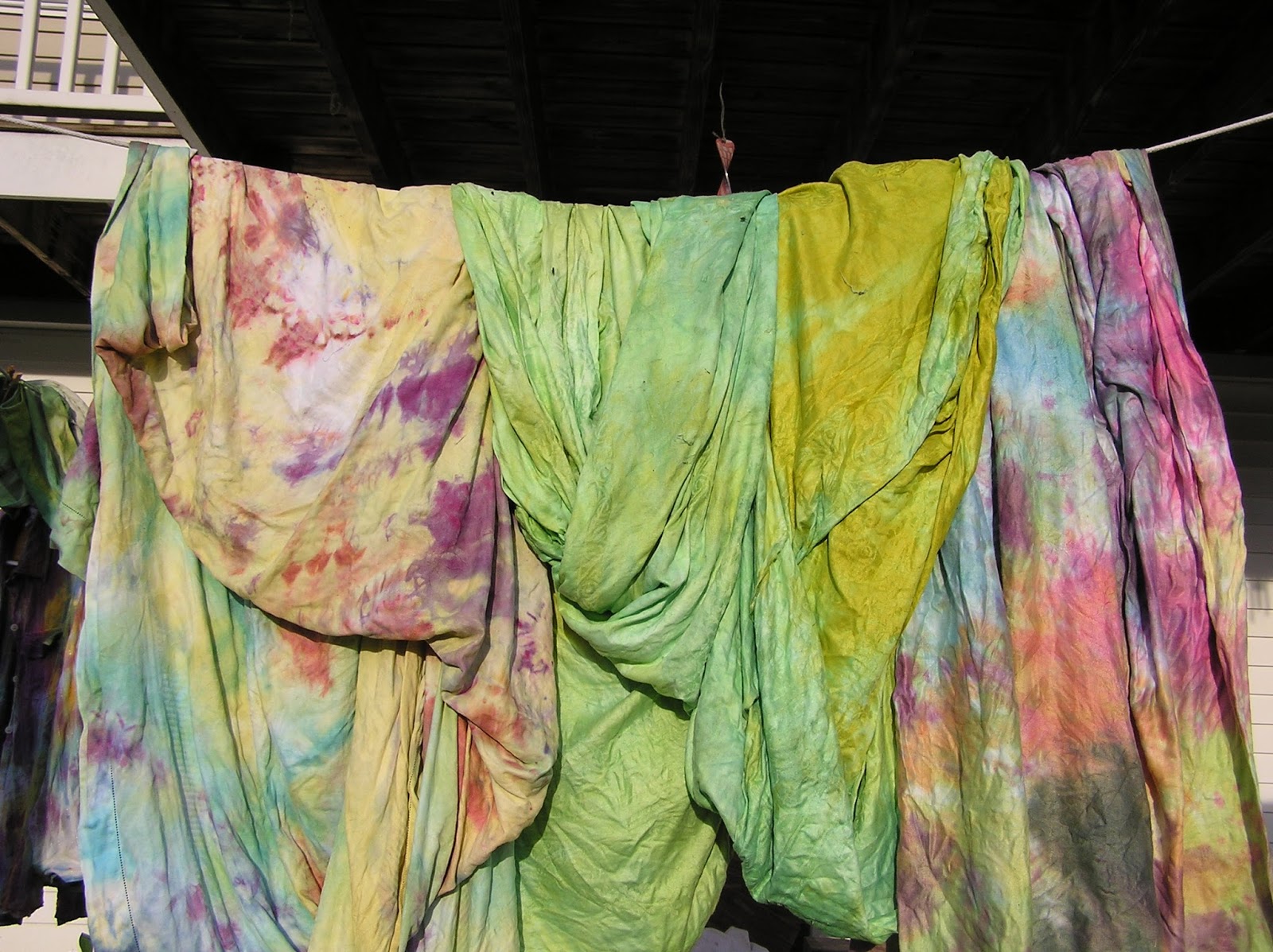
I really hope that my elderberries start growing this year, I need to find space for dahlias, and I want to plant some rows of wildflowers so I may easily harvest them for dyes. I have gathered seeds from ironweed and Joe Pye weed from my meadow. Soon, the horsetails will be sprouting in the ditch along the road. I love the pale green I got from them last year. Speaking of flowers, I am working on a floral wall hanging that I plan to offer as a creative workshop and "pattern" that will be available on my Etsy shop soon. It will probably be a month yet before it is finished and up for purchase.
I always seem to dream bigger dreams than I have time, energy and ability to achieve. At least I have grand dreams, I encounter too many people who don't seem to have dreams. What are your dreams for this spring?
Monday, March 7, 2016
First Outdoor Art Fair
I know that this is a bit far in advance, but I am excited to announce that I have a space at Art on the Hill on July 9, 2016 in Mantua, Ohio. This will be my first venture in selling finished art at an event. Now I need to get a pop-up tent, make a sign, and figure out how to display my wares. July will be here before I know it!

I'm working on a whole lot of my fabric boxes for this. I will also have some 2-D wall hangings and I will take a small selection of hand-dyed fabric.

I'm sure the next few months will be full of adventures in the prep for this event, so check back to see what sort of trouble I've gotten into!

I'm working on a whole lot of my fabric boxes for this. I will also have some 2-D wall hangings and I will take a small selection of hand-dyed fabric.

I'm sure the next few months will be full of adventures in the prep for this event, so check back to see what sort of trouble I've gotten into!
Thursday, February 25, 2016
Embroidery Stitches
Whenever I get together with other art quilters, talk often
turns to techniques and where one gets their ideas or where they learned a certain
way of doing something. I have been
wanting to talk about textile art resources for a while now, so here is the
first of a periodic series on what I have been using to learn. NOTE:
I do not receive any compensation for mentioning any book, product or
individual on this blog!

I have been working on a (somewhat) weekly project, making a
fabric postcard sampler of hand embroidery stitches. The amazing array of textures created by hand
stitching in crazy quilts and ribbon embroidery was probably the biggest factor
in my finally learning to sew and jumping into art quilting. Over the past few years, I have amassed a
stack of books on fancy stitches. I keep
coming back to four of them more than any of the others.
For my weekly stitch samples, I have slowly been working my
way through the Embroidery and Crazy Quilt Stitch Tool by Judith Baker
Montano (C&T Publishing, 2008). You
really can’t go wrong with any of her books, but I feel that this is the best
of her stitching books if you want to learn stitches. No images of her stunning stitch work here,
just clear instructions on creating some 180 thread and ribbon stitches, very
easy from which to teach oneself. My
little project consists of making one postcard per stitch, and I use as many different
threads as I can, resulting in my own visual stitch journal/”dictionary.” It is a great reference for choosing a thread
and stitch for a certain look that I want to achieve, and sometimes it is a
reminder that some stitches don’t look so great in some threads. If something doesn’t work out, I leave it as
a reminder.
Another stitch guide that I refer to frequently is Creative
Stitching by Sue Spargo (self-published, 2012). This source covers only about 50 stitches,
and there is some duplication with the Montano book, but there are enough other
stitches not in Montano to make it worthwhile.
Spargo also gives helpful recommendations on what needles to use for each
stitch.
Once I’ve mastered the basics of some new stitches, I look
to Montano’s Free-Form Embroidery (C&T Publishing, 2012) and The
Magic of Crazy Quilting by J. Marsh Michler (Krause Publications, 2003) for
endless inspiration on combining and altering stitches by stretching and
overlapping.
As I mentioned, I have other books on embroidery stitching,
and there are more than that out there, these are simply then ones I use most
often.
Tuesday, February 16, 2016
Art quilt labels, the end of the series
Labels, part three
One more go around with the labels, then I will move on to
something else. One of the opinions that
arose in the SAQA list discussion was that art quilters (textile artists)
should just follow the status quo of the established fine arts world, and just
put your name and title on the piece, nothing more. The more I think about that, the more I dislike
it. If I were buying a painting, new or
old, I would like to know more about it than a name and title. As an art quilter, this is one area where I
don’t want to emulate the greater art world.
I also feel that informative labels might help in our
crusade to gain more acceptance in the greater art community. What a great way to educate potential buyers
who are unfamiliar with art quilting.
This is yet another way to be good ambassadors for our chosen form of
expression. When I see an art label with
some background about the individual piece, it tells me that the artist really
cares about it, and wants other people to care too. Not that lack of a label means the artist
doesn’t care, but I like it when I see someone go the extra distance.
As I asked in my last post, what sort of legacy will you
leave as an artist? If you don’t want
art collectors (or museums, galleries) to know about your work, why are you
making things? The information on your
website is only going to last as long as you keep paying for the site
hosting. In what other venues do you
have your biographical information as an artist? I used to work in an art museum in a major Midwestern
city that has an extensive archive on artists that either were born in that
city, were educated there, or lived for more than one year there. Someday, I should find out if similar artist
archives exist elsewhere.
Subscribe to:
Posts (Atom)