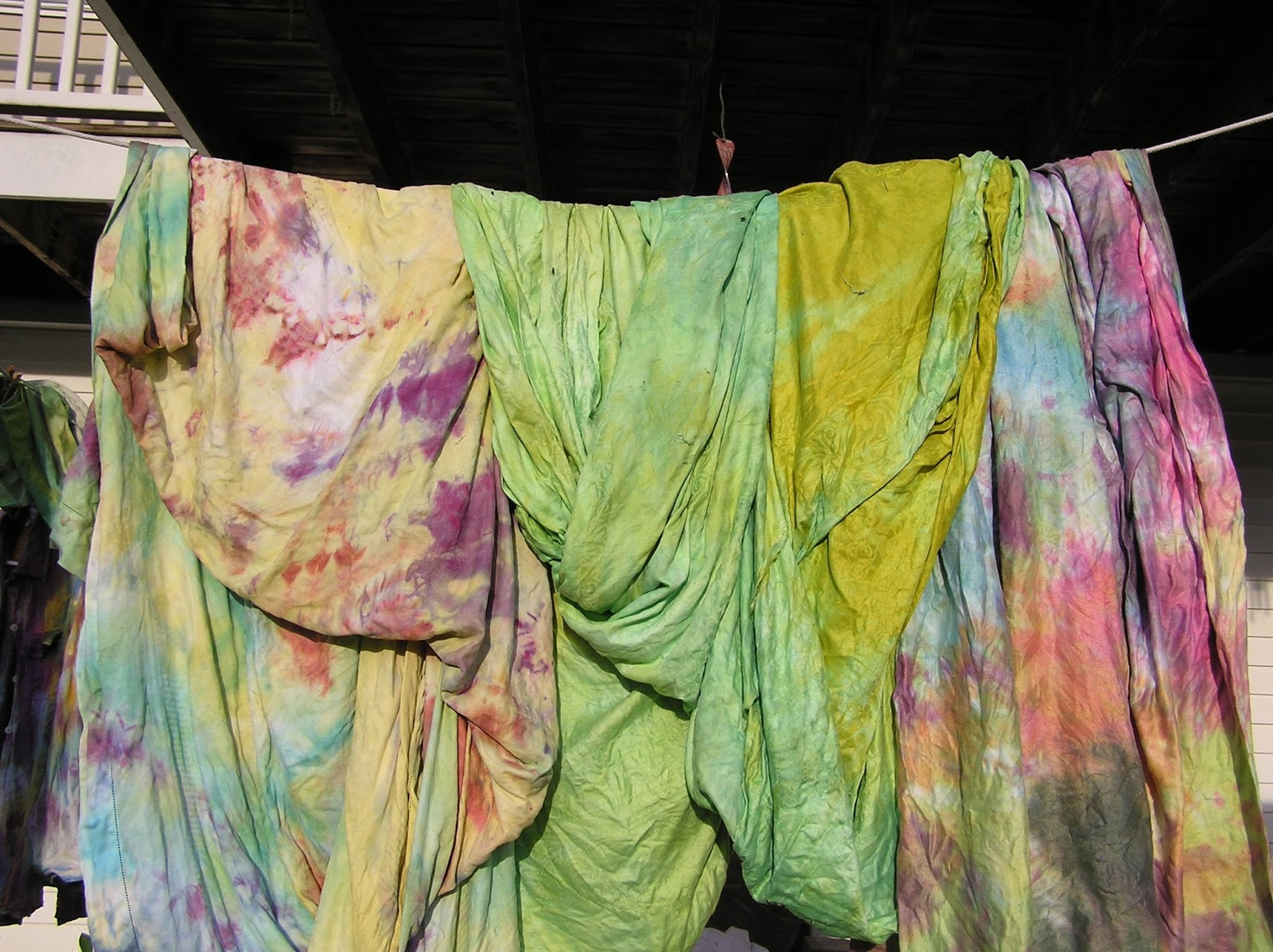
I'm in a garden planning mode this week, after my hollyhock dye adventures from the weekend. I usually plan and plant more than I can reasonably handle, not just in gardening, but in other aspects of my life. So many dreams, so little time! The weeds start getting ahead of me halfway through the season, and end up hiding ripe vegetables from my sight.
With these grandiose gardens in my head, here's five things I want to plant and use for dyeing:
1. Dyer's Coreopsis (Coreopsis tinctoria) (pictured above)
2. Safflower (Carthamus tinctorius)
3. Dahlia (Dahlia sp.)
4. Woad (Isatis tinctoria)
5. Japanese Indigo (Persicaria tinctoria/Polygonum tinctorium)
I have had Coreopsis and Woad in my garden, and I let them go to seed to have more plants in the next year for dyeing. Sadly, I got wrapped up in other things and forgot to watch for the seeds. I hope they sprout on their own this year, and that I don't pull the seedlings, thinking they are weeds.
Showing posts with label plant dyes. Show all posts
Thursday, March 29, 2018
Tuesday, March 27, 2018
Hollyhocks in March
I should have been making double use of my wood-burning stove all this past winter, simmering small batches of natural dyes. I finally cooked up a couple of pots this past weekend. First was a trial of purple onion skins:
There is no use in separating the varieties of onions, they all turn out the same on fabric. The purple onion turned out the same as a batch of yellow onions that I did a while ago. I like the golden color that they impart on the silk.
Next I tried two batches of dried hollyhock flowers. I had high hopes for these, as the flowers I started from seed two years ago. Hollyhocks are biennial, they don't bloom until their second year, and then the plants die. To keep biennials going in a garden, they must be planted each year to keep the blooms coming each season. Last summer, my hollyhocks were just stunning, and I want to continue their splendor in fabric.
The batch of red hollyhock was a bust. The water turned a murky rose color, but it did not take to the fabric. The "black" hollyhocks (see above picture) were a success - lovely tones of blue-green!
I neglected to plant hollyhock seed last summer, so I might not have any this season, but I will plant them soon to have blooms in 2019. I want to try dyeing with fresh flowers from them.
There is no use in separating the varieties of onions, they all turn out the same on fabric. The purple onion turned out the same as a batch of yellow onions that I did a while ago. I like the golden color that they impart on the silk.
Next I tried two batches of dried hollyhock flowers. I had high hopes for these, as the flowers I started from seed two years ago. Hollyhocks are biennial, they don't bloom until their second year, and then the plants die. To keep biennials going in a garden, they must be planted each year to keep the blooms coming each season. Last summer, my hollyhocks were just stunning, and I want to continue their splendor in fabric.
The batch of red hollyhock was a bust. The water turned a murky rose color, but it did not take to the fabric. The "black" hollyhocks (see above picture) were a success - lovely tones of blue-green!
I neglected to plant hollyhock seed last summer, so I might not have any this season, but I will plant them soon to have blooms in 2019. I want to try dyeing with fresh flowers from them.
Tuesday, November 14, 2017
Black Walnut Harvest
For the past two years, my black walnut trees have not produced any nuts, which has been incredibly disappointing as I look forward to them for eating and for fabric dyeing. This year - a bumper crop!
This is what I pick up from underneath the trees:
The thick, soft outer hull must be first be removed, best accomplished by smashing them with a brick. I save the hulls for fabric dyeing. At this point, I rinse the walnuts and let them dry for a week or two. There is still the concrete hard inner shell to be smashed.
Once they are dried, it will be time to crack them open, pick out the nut meats, and freeze them for future use in cookies, cakes and quick breads. It is a very labor intensive process, making one realize why black walnuts are so expensive in the stores. The same concept applies to art work. It is not easy making things, but I find it worthwhile.
This is what I pick up from underneath the trees:
The thick, soft outer hull must be first be removed, best accomplished by smashing them with a brick. I save the hulls for fabric dyeing. At this point, I rinse the walnuts and let them dry for a week or two. There is still the concrete hard inner shell to be smashed.
Once they are dried, it will be time to crack them open, pick out the nut meats, and freeze them for future use in cookies, cakes and quick breads. It is a very labor intensive process, making one realize why black walnuts are so expensive in the stores. The same concept applies to art work. It is not easy making things, but I find it worthwhile.
Thursday, April 27, 2017
Flower Pounding
I continue to be amazed at the multitude of techniques for fabric surface design. I just made a quick trial of flower pounding, inspired by one of the books I just purchased in Fredericktown: Flower Pounding by Ann Frischkorn and Amy Sandrin (C&T Publishing, 2000). Flower pounding is just as is sounds, hammering fresh flowers into prepared fabric. The fabric (cotton muslin) is prepared just as you would for dyeing with plant dyes - alum and soda ash.
A quick tour of my property for blooms yielded violets, lilac, bluets, spring beauty, pink dogwood, redbud and weigela. Here is a sampler of those flowers:
The lilac was most disappointing. I love the clusters of the tiny pale purple flowers this time of year, and the air now is heavy with their scent. The pounding process on the lilacs only resulted in a murky pinkish-brown. The bluets and spring beauties, tiny delicate wildflowers, dissolved into a pulpy mess. The redbuds had nice color, the weigela was another murky mess. The pink dogwood - oh, my! It actually came out darker than the fresh flower, and the parallel veins imprinted onto the fabric -lovey! The violets went splotchy, but notice the color of the flowers. Are you thinking what I'm thinking? What would happen with violets in a dye bath? I have one little piece of prepared silk that didn't make it into the last plant dye session. It might take a lot of violet flowers to do it, but I am going to try dyeing with them.
One important matter when you are collecting plants or flowers from the wild: be sure you are not picking anything that is rare or endangered, and no matter what, only take what you need. For every one that you pick, leave at least ten of the same plant undisturbed.
Oh yes, here's more of the lovely pink dogwoods:
Happy spring!
A quick tour of my property for blooms yielded violets, lilac, bluets, spring beauty, pink dogwood, redbud and weigela. Here is a sampler of those flowers:
The lilac was most disappointing. I love the clusters of the tiny pale purple flowers this time of year, and the air now is heavy with their scent. The pounding process on the lilacs only resulted in a murky pinkish-brown. The bluets and spring beauties, tiny delicate wildflowers, dissolved into a pulpy mess. The redbuds had nice color, the weigela was another murky mess. The pink dogwood - oh, my! It actually came out darker than the fresh flower, and the parallel veins imprinted onto the fabric -lovey! The violets went splotchy, but notice the color of the flowers. Are you thinking what I'm thinking? What would happen with violets in a dye bath? I have one little piece of prepared silk that didn't make it into the last plant dye session. It might take a lot of violet flowers to do it, but I am going to try dyeing with them.
One important matter when you are collecting plants or flowers from the wild: be sure you are not picking anything that is rare or endangered, and no matter what, only take what you need. For every one that you pick, leave at least ten of the same plant undisturbed.
Oh yes, here's more of the lovely pink dogwoods:
Happy spring!
Thursday, April 6, 2017
Slovenian Easter Eggs
I recently discovered an intriguing Slovenian tradition that will be of interest to dyers and surface design people. The tradition is pirhi, a method of using plants to not only dye, but decorate, Easter eggs. Small flowers and leaves are wrapped around raw, whole eggs, then boiled in a pot of onion skins, cooking the eggs and coloring the shells in one step. The leaves or flowers act as a resist, leaving a lighter imprint on the eggshell.
Not the sort of egg to use for pirhi!
If only I hadn't used all of my onion skins for a small silk dye bath over the winter! I want to try this. I'm sure I could use any edible dye plant for pirhi, perhaps red cabbage or beets for starters. I learned about the pirhi tradition from Our Voice, the newspaper of the American Mutual Life Association, Cleveland, OH (3/14/17). There is a short video of the pirhi process here. Enjoy!
Later this month, I will make my own pirhi, be sure to check back for the results. Meanwhile, I have more ramblings about children's book illustrators. and one of these days I am going to quilt that purple collage! Next week, I will also write a bit about my visit to the Original Creative Festival.
Tuesday, February 28, 2017
Sunflower Silk
I truly have far more ideas than I have time. There are three future posts in my head, based on some observations I have made from children's' books, and I am lacking the time to develop and type them... at least this week. I have simply tried to jam too much into this week.
Anyway, here's the result of a little fabric dye experiment I managed to do over the past weekend:
I dyed silk with sunflower seed hulls, scraped up from beneath my bird feeders! I'm not sure I will bother to do that again, the color isn't anything great. I might try growing a variety of sunflowers cultivated by the Hopi for dyeing their wool rugs. Maybe a different variety will yield stronger colors.
Anyway, here's the result of a little fabric dye experiment I managed to do over the past weekend:
I dyed silk with sunflower seed hulls, scraped up from beneath my bird feeders! I'm not sure I will bother to do that again, the color isn't anything great. I might try growing a variety of sunflowers cultivated by the Hopi for dyeing their wool rugs. Maybe a different variety will yield stronger colors.
Wednesday, February 8, 2017
Onion Dye
I have not been accomplishing much these past couple of weeks, but I have dabbled in a couple of odd projects. Both were fabric dyeing projects, and ones that I could start and leave sit to do other things. First was a batch of silk, dyed with onion skins:
It took me two years to save up enough onion skins to be able to dye a few pieces of silk. I am not a fan of onions; I only use a little bit of them here and there in cooking. I am pleased with the lovely color, even though it is similar to the color that the dahlias yielded last fall. Isn't it amazing how much darker the silk chiffon dyed? (The chiffon is the rumpled fabric on the right.) For the first time in my plant dye adventures, the basement did not smell like rotten... something during the simmering process. It simply smelled like I was cooking onion soup, not a bad smell, just not something I would ever eat!
Tomorrow, I will show off my latest rust dyed fabric.
It took me two years to save up enough onion skins to be able to dye a few pieces of silk. I am not a fan of onions; I only use a little bit of them here and there in cooking. I am pleased with the lovely color, even though it is similar to the color that the dahlias yielded last fall. Isn't it amazing how much darker the silk chiffon dyed? (The chiffon is the rumpled fabric on the right.) For the first time in my plant dye adventures, the basement did not smell like rotten... something during the simmering process. It simply smelled like I was cooking onion soup, not a bad smell, just not something I would ever eat!
Tomorrow, I will show off my latest rust dyed fabric.
Saturday, December 17, 2016
Hollyhocks in December
An extra post this week, as I am excited about my hollyhock dyed silk! I was expecting some deep red-violet colors, instead I got this:
Interesting gray-green shades; color I thought was not possible without an iron modifier (something I have not tried yet). I used flowers from a "black" hollyhock that I started from seed.
Maybe the red-violet color that was indicated in the book could be achieved with flowers from true red hollyhocks. I will plant both red and black hollyhocks in 2017.
Interesting gray-green shades; color I thought was not possible without an iron modifier (something I have not tried yet). I used flowers from a "black" hollyhock that I started from seed.
Maybe the red-violet color that was indicated in the book could be achieved with flowers from true red hollyhocks. I will plant both red and black hollyhocks in 2017.
Thursday, December 15, 2016
Marigolds in December
On this bitter cold and snowy day, I'm cooking up some fabric! I saved some marigold flowers at the end of the gardening season, and I am just now getting around to dyeing with them.
I am pleased, a nice variety of shades just by using different silks (dupioni, noil, organza, habotai, etc.). There is a pot of dried hollyhock flowers on the woodburner right now, I'm hoping for some deep purple-red shades.
Speaking of cooking, I've wanted to rant a bit about a book I recently read on being a creative artist. I'm not going to reveal the author, I'll keep this anonymous. The author devoted an entire page in this book on why she hated to cook. Her complaint was that it took away from her painting time, and that painting was all she wanted to sustain her. I get it that is sometimes troublesome to stop progress on an creative project to take care of chores and yes, even basic needs. But, we have to take care of ourselves, not just in satisfying our creative impulses. I wrote a related post on this quandary on August 25, long before I read the book I just described. Creativity should filter through to all aspects of our lives, that is one reason why art matters. What ways can you foster more creativity in your everyday routine?
Thursday, June 23, 2016
Rainy Day Ramblings
One more thought about the Ohio Annual show, actually about juried shows with prizes as a whole...
I wonder if the criteria for the selection of prize winners is vastly different than the general selection of entries. I'm sure that there are probably as many answers to that as shows and jurors, but I really would like to know what they are looking for. It would help the entrants decide what shows are worth trying to get into for what they create. Yes, I realize that the prospectus for each show sets certain parameters, but there are still many mysteries about the process, I think. As I mentioned in the last past, I pay attention to any bits from jurors that reveal insight into the process. Of course, understanding the selection criteria goes out the window when a show has to whittle 500 submissions into 50 acceptances. I'm sure there's always a vast amount of worthy entries that don't get in just for lack of space, and not because they are not good.
Enough of the heavy stuff, I have pretty flowers blooming! These are some hollyhocks that I started from seed last year for dyeing:
The plant on the left is a wild mullein, not useful for dyeing (not that I know of), but I like it, so it stays in my gardens. I like the native wildflowers too.
I still have not ordered any silk for plant dyeing! I had dreams of having lots of plant dyed fabrics for the quilt shows this year, but I have learned that it takes a whole lot of plant material to dye a fat quarter of fabric. Add in the work of the whole dyed process, the expense of the fabric, and the cost of the finished product skyrockets. I will have a few plant dyed fabrics available from time to time, it just won't be something that I will feature regularly.
I wonder if the criteria for the selection of prize winners is vastly different than the general selection of entries. I'm sure that there are probably as many answers to that as shows and jurors, but I really would like to know what they are looking for. It would help the entrants decide what shows are worth trying to get into for what they create. Yes, I realize that the prospectus for each show sets certain parameters, but there are still many mysteries about the process, I think. As I mentioned in the last past, I pay attention to any bits from jurors that reveal insight into the process. Of course, understanding the selection criteria goes out the window when a show has to whittle 500 submissions into 50 acceptances. I'm sure there's always a vast amount of worthy entries that don't get in just for lack of space, and not because they are not good.
Enough of the heavy stuff, I have pretty flowers blooming! These are some hollyhocks that I started from seed last year for dyeing:
The plant on the left is a wild mullein, not useful for dyeing (not that I know of), but I like it, so it stays in my gardens. I like the native wildflowers too.
I still have not ordered any silk for plant dyeing! I had dreams of having lots of plant dyed fabrics for the quilt shows this year, but I have learned that it takes a whole lot of plant material to dye a fat quarter of fabric. Add in the work of the whole dyed process, the expense of the fabric, and the cost of the finished product skyrockets. I will have a few plant dyed fabrics available from time to time, it just won't be something that I will feature regularly.
Thursday, June 9, 2016
Book Review - Natural Dyeing
Book review time! I
thought I’d profile the sources I have on plant dyes, as I am eagerly anticipating
the first hollyhock flowers soon. I am
also seeing yarrow flowers opening and the horsetail is proliferating in the
roadside ditches. I need to order some
silk yardage! Here are the books that I
have on my shelf:
Wild Color: The Complete Guide to Making and Using Natural
Dyes. Jenny Dean, with Karen Diadick
Casselman, Octopus Publishing (Watson-Guptill/Crown Publishing/Random House),
revised edition – 2010.
This is
the best single source I have found on plant dyes. Easy-to-follow, concise step by step
instructions, clear photographs and a section that profiles a good selection of
dye plants with the colors that they yield.
Highly recommended for the beginning dyer and anyone who wants to grow
their own dye plants.
The Complete Guide to Natural Dyeing. Eva Lambert and Tracy Kendall, Interweave
Press, 2010.
Another
excellent source with step by step instructions and accompanying photographs. The focus is almost strictly on prepared
natural dyes mail ordered from supply companies. It only briefly glosses over collecting dye
plants. The concept of growing your own
plants is apparently completely ignored.
Suitable for those who can’t have or don’t want their own garden.
A Dyer’s Garden. Rita Buchanan, Interweave Press,
1995.
Very
good source, smaller and shorter book than the others mentioned here. Definitely for gardener artisans. The dye process instructions are written in
prose, so I would recommend this for those who have done some natural dyeing,
or as an additional resource to supplement one of the first two books listed
here. Great descriptions of dye plants
and their cultivation.
Eco Color: Botanical Dyes for Beautiful Textiles. India Flint, Interweave Publishing, 2008.
Interesting
idea source for the advanced dyer, in-depth processes, but not concise. Lots of interesting science and history
information, loaded with overwhelming artsy photographs. Worth the cost for a thorough list of natural
dye plants from around the world.
The Handbook of Natural Plant Dyes. Sasha Duerr, Timber Press, 2010.
Harvesting Color: How to Find Plants and Make Natural
Dyes. Rebecca Burgess,
Artisan/Workman Publishing, 2011.
I’ll
discuss these two books together, since they are very similar. Quite frankly, neither of these two books
have been very useful for me. The
organization is rather haphazard, but there is some good information and
instruction scattered throughout, the reader has to work a bit to glean it. If one wants to take the time, I would
recommend writing notes from these two into something to use in the dye work
area. The Burgess book is marred by
frequently blurry and oddly cropped photographs (the headless torsos holding
plants are just plain creepy), and I was horrified to see images of bare hands dipped
in pokeberry juice, which is toxic (and it is stated so in the text of the
book!) Both books are targeted for single-project
dyers who might embark on dyeing once or twice a year.
Thursday, March 10, 2016
Springing into New Projects
It has been unseasonably warm this week in my neck of the woods, which has me looking forward to a fresh season of fabric dyeing and planting for natural dyes. I just got my new Dharma catalog too, I have to take inventory on my dyes and supplies and run up the credit card again!
I really hope that my elderberries start growing this year, I need to find space for dahlias, and I want to plant some rows of wildflowers so I may easily harvest them for dyes. I have gathered seeds from ironweed and Joe Pye weed from my meadow. Soon, the horsetails will be sprouting in the ditch along the road. I love the pale green I got from them last year. Speaking of flowers, I am working on a floral wall hanging that I plan to offer as a creative workshop and "pattern" that will be available on my Etsy shop soon. It will probably be a month yet before it is finished and up for purchase.
I always seem to dream bigger dreams than I have time, energy and ability to achieve. At least I have grand dreams, I encounter too many people who don't seem to have dreams. What are your dreams for this spring?
I really hope that my elderberries start growing this year, I need to find space for dahlias, and I want to plant some rows of wildflowers so I may easily harvest them for dyes. I have gathered seeds from ironweed and Joe Pye weed from my meadow. Soon, the horsetails will be sprouting in the ditch along the road. I love the pale green I got from them last year. Speaking of flowers, I am working on a floral wall hanging that I plan to offer as a creative workshop and "pattern" that will be available on my Etsy shop soon. It will probably be a month yet before it is finished and up for purchase.
I always seem to dream bigger dreams than I have time, energy and ability to achieve. At least I have grand dreams, I encounter too many people who don't seem to have dreams. What are your dreams for this spring?
Tuesday, October 6, 2015
Streetsboro Quilt Show
If you have found your way to my blog after meeting me at the Streetsboro Quilt Show, welcome! Thank you to those who made a purchase from me. The hand dyed fabric and related art quilting goodies are my livelihood now; I appreciate your support, and I'd love to see what you make with my fabric.
Over the next few weeks I will be posting instructions for various things you can do with the vintage and unusual products I sell: flowers from hankies or lace trim, machine sewn yarn "lace," and couching fancy yarns. Keep checking back. I am trying to get into the habit of posting on Tuesdays and Thursdays.
In my last post, I wrote about several plants I use as dyes, but I did not have an image for the dahlias. Over the weekend, I gathered a gorgeous bouquet of them from my mother's garden. Dahlias have been bred to an amazing array of colors and variances in flower and petal form. Some avid growers of them show their flowers at judged events with passion on the levels of horse and dog shows. We enjoy them at home, and when these blooms fade, their color will be captured in some silk that I have waiting.
We always need beautiful things to look at in a world full of people doing ugly things.
Over the next few weeks I will be posting instructions for various things you can do with the vintage and unusual products I sell: flowers from hankies or lace trim, machine sewn yarn "lace," and couching fancy yarns. Keep checking back. I am trying to get into the habit of posting on Tuesdays and Thursdays.
In my last post, I wrote about several plants I use as dyes, but I did not have an image for the dahlias. Over the weekend, I gathered a gorgeous bouquet of them from my mother's garden. Dahlias have been bred to an amazing array of colors and variances in flower and petal form. Some avid growers of them show their flowers at judged events with passion on the levels of horse and dog shows. We enjoy them at home, and when these blooms fade, their color will be captured in some silk that I have waiting.
We always need beautiful things to look at in a world full of people doing ugly things.
Friday, September 25, 2015
More Plant Dye Adventures
I finally got around to mordanting some silk and a bit of
wool fleece to trial the late summer flowers in the dye pot. The first test was not a flower, but a pint
of blueberries that got pushed to the back of the fridge. I normally would not use edible goods for
dyeing, but by the time I found the blueberries, they were not fit for human
consumption. They yielded a nice
blue-violet color with some interesting green mottling. I anticipate that the color will fade over
time, as most berry dyes are prone to do.
Next, I tried a batch of Joe Pye Weed, an immensely tall
plant that blooms a large cluster of wispy dusty pink florets. I know enough already to never expect that a
plant will yield the color of its flowers.
The Joe Pye resulted in a nice golden color.
Speaking of not getting results that you expected, I did
expect a nice red-violet color from some hibiscus flowers. What I got was a murky green-gray. Not at all what one of my books
promised. I have no idea what went wrong. I tried the hibiscus twice, same result.
After the hibiscus disappointment, I cooked up a pot of
ironweed. The flower clusters of this
plant are a vibrant red-violet, so intense that you might not think they are
real. It would be amazing if the flowers
really did impart their color in the dye bath.
The ironweed, after rinsing, drying and pressing, turned out to be….
The same color as the Joe Pye Weed! The ironweed is on the left, Joe Pye Weed on the right in the above image. I knew I was not going to get a bright
pink-red; the one book that discussed ironweed as a dye indicated it would
result in a bright pale green. I am starting
to re-think my grand scheme to have a big dye plant garden and sell yards and
yards of lovely plant dyed fabric. At
least not anytime soon, I have lots of learning yet, and tinkering with process
and recipes.
Last week, my mom brought me a nice bouquet of dahlias from
her garden. When the flowers faded, they
went into the dyepot. The silks came out
a very pale creamy orange. At last,
something a little different! They
soaked in the dye for over 24 hours, so I am a bit surprised that the color was
so light. I am going to re-read the
mordanting instructions, I must be skipping something.
Next on my list: sumac berries, marigolds, beets and
goldenrod.
Friday, June 5, 2015
Spring plant dye: Horsetail
Now that spring is well underway, I have a steadily increasing
amount of different plants to try as dyes.
There is a shallow ditch running along the road frontage of my family’s
acreage that is filling in with horsetails.
By horsetails, I ‘m not talking about the last part of Secretariat to
cross the finish line, these horsetails are Equisetum
arvense, a bright green, stiff, spindly, primitive plant. The Equisetums are fascinating plants, “closely
allied to the prehistoric order of the Calamitales, large and abundant treelike
plants of the Carboniferous period nearly three hundred million years ago.” (Boughton Cobb, A Field Guide to Ferns and
their Related Families, Houghton Mifflin, 1963, p. 194) Horsetails may be used for dyeing, here is
the result:
A nice light tint of yellow green on the cottons, a bit
darker on the silk. I added a bit of
alkaline modifier in the form of wood ash solution to one pot, and it seemed to
lighten the color. I’ve given up on
weighing and measuring like most of my sources suggest. Rough visual estimates are working fine for
me, and if a batch of fabric doesn’t turn out, I’ll just try it again with a
new dyebath.
I’ve always had a deep appreciation for the natural world, I
spent summers as a youngster tagging along with my mother to her job at a
natural history museum. Now that I am
living on rural acreage, I am reacquainting myself with the wild flora and
fauna. While I was harvesting horsetails
for dyeing, I was reminded of Albrecht Durer’s Great Piece of Turf watercolor from 1503. The longer I concentrated on a square
foot of meadow edge, I found more and more different plants. Tip of the day: Never completely strip an
area of a plant you are collecting, only take a fraction of what is there, and
collect only if there is an abundance of what you seek. Of course, don’t trespass either!
Subscribe to:
Posts (Atom)