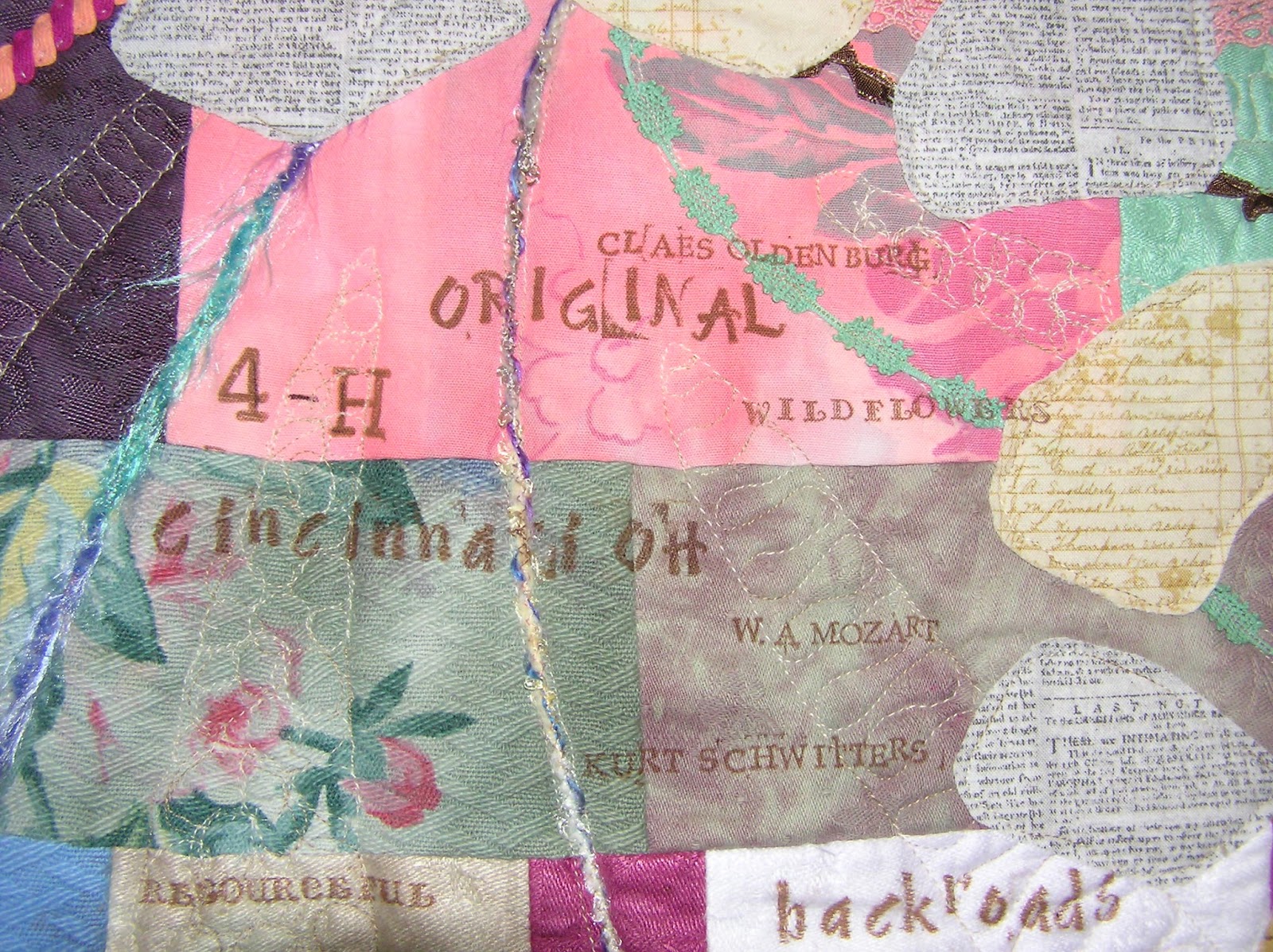
Not having learned traditional quilting means that I have no qualms about doing somewhat unorthodox things to fabric. I have recently amassed a collection of new rubber stamps for my art journaling class supply base. Why use them just on paper? I have already used them on my "What's Your Story" challenge entry in the Mutton Hill Quilt Show:
Since I was stamping on the quilt after putting all three layers together, I had a lot of ink "over-slop." The stamps sunk into the soft surface and left the excess ink that was picked up. I probably over inked the stamps too, but everything remained legible. I'm fine with that.
I am still adding to my collection of alphabet stamps, I just bought a vintage set of them at the local junk auction for $1.
I should have sorted through them before the auction started, as a few letters are missing. No problem, I could just mix fonts in a sort of ransom note style. Then, there is always Ebay; I found a probably identical set of stamps, complete. This second set is already on its way to me. I will keep and use both sets, of course.
Showing posts with label auctions. Show all posts
Thursday, December 21, 2017
Tuesday, September 12, 2017
Auction Wins and Losses
Astonishingly, my sickly, blight-stricken tomato plants are continuing to produce beautiful fruit. I've been canning more sauce for the winter, while gazing out at a goldenrod, Joe-Pye-Weed and ironweed filled meadow that will have to wait for another year to be simmered with silk and wool to create lovely colors.
I slipped out to the local junk auction last night, and came home with some more vintage damask linens to dye. I was outbid on a handful of lovely doilies and a generous fat quarter of vintage bark cloth. I have my limits on bidding, and even though I really wanted the doilies and bark cloth more than anything else on my list last night, I did not want to pay much. I keep getting outbid or just making dumb decisions on bark cloth and vintage printed feed sack cloth. Twice in the last three years, I have found a large box of uncut feed sacks, only to leave each auction before they even started because I didn't want to sit through half a day for one box of stuff. Of course, the boxes might have gone for far more then I could have paid, I don't know.
So here are five things I really want to find in the waning auction season this year:
1. Bark cloth
2. Feed sacks
3. Wooden ironing boards
4. Elna model 50 sewing machine (the "Grasshopper")
5. A really good deal!
I slipped out to the local junk auction last night, and came home with some more vintage damask linens to dye. I was outbid on a handful of lovely doilies and a generous fat quarter of vintage bark cloth. I have my limits on bidding, and even though I really wanted the doilies and bark cloth more than anything else on my list last night, I did not want to pay much. I keep getting outbid or just making dumb decisions on bark cloth and vintage printed feed sack cloth. Twice in the last three years, I have found a large box of uncut feed sacks, only to leave each auction before they even started because I didn't want to sit through half a day for one box of stuff. Of course, the boxes might have gone for far more then I could have paid, I don't know.
So here are five things I really want to find in the waning auction season this year:
1. Bark cloth
2. Feed sacks
3. Wooden ironing boards
4. Elna model 50 sewing machine (the "Grasshopper")
5. A really good deal!
Tuesday, September 6, 2016
More Auction Treasures
If you are looking for creative inspiration, there is so
much in your own community. This past
weekend for me was chock full of local history.
I attended an estate sale and an estate auction and came away with more
knowledge of the area I now call home and some great future art project
ideas.
The first sale yielded a small collection of gravestone
rubbing how-to books and supplies, among other items. Old cemeteries are a great source for local
history and genealogy, and potential places to observe folk art stone carving. I have already been well acquainted with incorporating
gravestone carving into my own art, first in ceramics, and now making crayon
rubbings on fabric. This is a printed
vintage tablecloth, pulled out of the weekly junk auction, covered in a collage
of gravestone rubbings:
Image copyright RPS, please do not pin or re-post
The auction was the estate of a couple who had printed the
town newspaper for decades. There were a
few rare local history books; I was soundly outbid on one lot of the books, but
I bought the second lot, and I am dutifully studying them. Half of the auction was the contents of the
house, the other half was the bulk of the printing items. The newspaper was apparently printed in a
shed at the back of the property. A
calendar from 1974 in the shed had a note on December 26 that read, “Last day
of Home Towner.” After the printing of
that last newspaper, the owner must have locked the shed and left it. I bought a boxful of copies of two local
history booklets that had been printed there and were authored by the couple. There were lots and lots of old metal
printing blocks for advertising, all of them went out of my price range. I would have liked to get a few for display
and to have something from this piece of area history. I didn’t want to bid too much on them, as the
metal plates were too shallow to use for rubbings, and I don’t want to get into
messy printing inks. I’m more interested
in things that I can use rather than just look at these days.
There were several boxes of 9 X 12” sheets of embossed
advertising graphics. They were embossed
in a positive orientation, which made them good for rubbings, if the fine
detail could be captured.
Image copyright RPS, please do not pin or re-post
I decided to take a
chance on them. Luckily, no one else
wanted them, I and have two large boxes full of the sheets and a boxful of the
monthly catalogs for the ad sheets from the manufacturer. The ad sheets I now have are from the mid to
late 1960s.
I have not been able to find much about these ad
sheets. All I have found so far is from
an Ebay listing from seller BenningtonBargains: “In the days
of hot type, advertisers would send these mats to newspapers who would pour
lead into them and then use the lead plate on presses to print the ads in
newspapers. These were generally discarded after the lead pouring. So
this mat is extremely rare.” It looks
like they are made of fine grained paper (heavier than cardstock) with some
sort of coating.
I am happy to report that they make great rubbings on fabric:
Image copyright RPS, please do not pin or re-post
They work decently with paper, although the sections with
finer detail do not turn out as well.
These open up so many creative possibilities in my collage
explorations. I will have some of the ad
sheets for sale at upcoming quilt shows, and I will list a few on my Etsy store
in the next week.
Tuesday, August 2, 2016
Auction find! Singer Sewing Machine adversting
I'll admit, I am rather easily distracted. While I am still basking in the glow of new fancy threads from my Lexington trip, the excitement has dimmed a bit due to this:
Something I had never heard of before, an annual almanac put out by the Singer Sewing Machine company. It is my latest find from the frequent junk auction near my residence. It is filled with the usual suspect information akin to the still published Old Farmer's Almanac, but of course peppered with useful articles and advertising about Singer sewing machines. This particular one still has a string through the hole in the upper corner, for hanging in an easily accessible location and its condition indicates that it was consulted frequently. It is a fascinating look back into another time; a postal rate chart (two cents an ounce for a first class letter), time of transit table from New York City to various locations around the world (two days to Quebec, 33 days to Singapore), an article on "The Family Medicine Cabinet." No one now knows what Jamaica Ginger was used for, on page 30, it was recommended as a stimulant for severe pain.
Also on page 30 is the following advice:
"Every sewing-machine operator should have a piece of white (cloth or paper) and a piece of black to put under the needle in threading. When the thread is black use the white cloth; with white thread the black. One who has never tried this will be pleasantly surprised with the help it gives."
Some of the Singer promotional articles are a historical gold mine. I'm especially intrigued by a discussion of their cabinet making processes in the almanac. And then there is the proclamation that Singer sewing machines were "America's chief contribution to civilization." (p. 45) Arrogant? Maybe not, the 1997 special edition of Life magazine listed the invention of the sewing machine at number 67 in their "100 Events of the Past 1,000 Years," and quoted Gandhi as claiming that the sewing machine was, "one of the few useful things ever invented." (p. 57) Learning to sew certainly has changed my life.
Image copyright RPS, please do not post elsewhere
Something I had never heard of before, an annual almanac put out by the Singer Sewing Machine company. It is my latest find from the frequent junk auction near my residence. It is filled with the usual suspect information akin to the still published Old Farmer's Almanac, but of course peppered with useful articles and advertising about Singer sewing machines. This particular one still has a string through the hole in the upper corner, for hanging in an easily accessible location and its condition indicates that it was consulted frequently. It is a fascinating look back into another time; a postal rate chart (two cents an ounce for a first class letter), time of transit table from New York City to various locations around the world (two days to Quebec, 33 days to Singapore), an article on "The Family Medicine Cabinet." No one now knows what Jamaica Ginger was used for, on page 30, it was recommended as a stimulant for severe pain.
Also on page 30 is the following advice:
"Every sewing-machine operator should have a piece of white (cloth or paper) and a piece of black to put under the needle in threading. When the thread is black use the white cloth; with white thread the black. One who has never tried this will be pleasantly surprised with the help it gives."
Image copyright RPS, please do not post elsewhere
Some of the Singer promotional articles are a historical gold mine. I'm especially intrigued by a discussion of their cabinet making processes in the almanac. And then there is the proclamation that Singer sewing machines were "America's chief contribution to civilization." (p. 45) Arrogant? Maybe not, the 1997 special edition of Life magazine listed the invention of the sewing machine at number 67 in their "100 Events of the Past 1,000 Years," and quoted Gandhi as claiming that the sewing machine was, "one of the few useful things ever invented." (p. 57) Learning to sew certainly has changed my life.
Tuesday, May 3, 2016
Rags Paper Ramblings
A quick journey down the road to check out an auction, mostly Amish goods. Dozens and dozens of farm fresh local eggs, homemade bread, cinnamon rolls, cookies. Some old junk, some new junk. Tomato plants, only slightly less sorry looking than my own plants started from seed. Nothing I wanted to stay for, saving some money. On the way home, I stopped by an S-bridge, a rather unique construction to this region.
How much longer will it last? How long will what I create last in this world? Consciously or unconsciously, we all try to make our mark in the world.
Thursday, April 28, 2016
Auction Adventures
Everyone has some vice, a weakness that they find difficult
to resist indulging. I have developed a
bit of an auction problem. Even as broke
as I am right now, I cannot resist the temptation to attend an estate auction
within a half hour or so drive. Now, I
am NOT a hoarder, not at all. I don’t go
to every possible auction, only the close by ones that have stuff that I
actively collect or could use for the textile art. I don’t buy things just to buy
something. Much of my auction attendance
is for business, since I use mostly old table linens, doilies and other vintage
textiles.
Last night, I went to an auction in a neighboring county. I felt apprehensive going to it, as it was
apparently the liquidation of a tiny historical society. Being one who is appreciative of local
history, I felt odd about the situation.
The offerings were rather mystifying considering the source (not a
complete list, but enough of a word picture):
Thousands
of 1970s to modern postcards
At least
100 sample advertising calendars from printing companies, none local
Loads of
unopened packs of cheap picture prints from the 1920s-1960s
Railroad,
coal and other industrial company papers, certificates, etc.
Lots and
lots of assorted advertising papers items, most with no local connection
5-6 boxes
of unused pop bottle labels from a bottler in another state
Lots of
worn, torn late 1800s/early 1900s clothing
That was the bulk of the auction, and I could not make any
rational connection between the stuff and the location. There were a few local items, but not what I
would have expected. If that was the
collection of the historical society, no wonder they had trouble staying open.
The best of my purchases was this:
It doesn’t look like anything great, yet, but that is the
sort of stuff I love to dye. A couple
small fancy tablecloths, some damask napkins.
Another flat:
Two torn old (before 1940, I guess) vests, two old
nightshirts (I think) and a black wool coat, maybe early 1900s? I don’t know fashion history. The coat, I don’t know what to do with. The rest of this flat will be cut up into
other things, I have a plan to make cotton paper pulp sculptures someday, and I
have a theory that old cotton will be great for that.
The last box:
Only part of the contents, but you get the idea - a lot of Victorian scrapbook cards, with some assorted advertising paper and a few calling cards from the late 1800s. Finally, some progress towards fulfilling the
“paper” part of my business name. I
already incorporate paper in some of my art quilts, and I want to make some
fabric and paper collages on canvas.
Here I go!
Thursday, January 7, 2016
Bolero
Bolero: n. 1. A lively Spanish dance in triple meter. 2. The music for this dance. 3. A waist-length jacket, with or without collar,
lapels and sleeves, worn open in front.
(Webster’s College Dictionary, Random House, 1995.)
I found this and one other bolero (the article of clothing) in
a big box lot of linens and doilies at a recent estate auction. I’m not sure if the estate was of a collector
or antiques dealer, I am guessing the latter, as there was not enough of any
one type of item to clearly establish a collection of that given group. Plus, nearly everything had a price tag on
it. I troll the local estate auctions
for vintage linens and other things I can use in my fabric dyeing and art
quilts. My first thought on these
boleros was why would anyone make, buy or wear a lacy sort of jacket that not
only doesn’t cover the torso, but will do nothing to keep you warm? Lately, I dress more for comfort. After I thought about my gut reaction more, I
realized that I cannot recall the last time I dressed up to go somewhere. There is an emotional benefit to getting “dolled
up,” at least once in a while. Why not
make and wear something beautiful?
However, since I have a closet full of dressy clothes that I
obviously am not wearing, I have put the boleros up on my Etsy store. My creative brain wants to dye them and alter
them, but I think they might be worth keeping as they are. I will give someone who is into historical costuming
the chance to give them a new home.
I think that the last time I dressed up and went out was about
three years ago (that long, really?) to a fantastic orchestra performance of
Rodrigo’s Concierto de Aranjuez, with
Pepe Romero as the guest soloist. One of
many classical pieces I would like to hear live is Ravel's Bolero. Somewhere, I have
heard that Bolero is the longest
crescendo in classical music. There is a great video of the Cincinnati Symphony Orchestra performing Bolero on YouTube.
I have been contemplating interpreting music in my textile
art. Other than illustrating a few Tom
Waits songs, I have yet to come up with any solid ideas on transforming sound
into fabric in such a way that the viewer would relate to the music. I think that using music would be a good way
to teach visual design, there are similarities to both. In the case of Bolero, an short theme is repeated on the timpani s throughout the
piece, and the other instruments echo it, while a melody is repeated through
the instruments, solo or in groups; repetition, variety and unity – both important
tools in visual design too. This is definitely a concept I will be working on this year.
Subscribe to:
Posts (Atom)