This is one of the embellishment techniques I was demonstrating at the quilt show last weekend. It is very easy, and quick to do. All you need is a length of wide lace trim, sewing thread and needle. I include several cuts of dyed lace trim in my Creativity Kits, available on my Etsy shop.
1. Cut a length of lace trim, 7" to 12" long, cut a length of matching thread, thread your needle and knot.
2. Fold 1/4" of short end of lace to the backside, bring needle up through fold. Sew a long running stitch along the long flat side of your lace trim, as close to the edge as is reasonable. Be sure to catch the thread in the thicker parts of the lace.
3. When you reach the other short end of the lace, fold 1/4' of the end to the backside of your lace, sew through the fold.
4. Gently pull the thread with one hand while holding the lace with your other hand. The lace trim will pucker and ruffle, and curve back on itself until the two short ends meet. Sew the short ends together with a few whipstitches. Knot the thread in the trim, and leave your thread end long to sew onto a project.
Here's a view of the backsides of two flowers:
It might be a bit difficult to see, but I usually take a few running stitches to the outside of the flower after pulling the thread and whipstitching the center. This further secures the flower and looks neater.
Friday, October 9, 2015
Tuesday, October 6, 2015
Streetsboro Quilt Show
If you have found your way to my blog after meeting me at the Streetsboro Quilt Show, welcome! Thank you to those who made a purchase from me. The hand dyed fabric and related art quilting goodies are my livelihood now; I appreciate your support, and I'd love to see what you make with my fabric.
Over the next few weeks I will be posting instructions for various things you can do with the vintage and unusual products I sell: flowers from hankies or lace trim, machine sewn yarn "lace," and couching fancy yarns. Keep checking back. I am trying to get into the habit of posting on Tuesdays and Thursdays.
In my last post, I wrote about several plants I use as dyes, but I did not have an image for the dahlias. Over the weekend, I gathered a gorgeous bouquet of them from my mother's garden. Dahlias have been bred to an amazing array of colors and variances in flower and petal form. Some avid growers of them show their flowers at judged events with passion on the levels of horse and dog shows. We enjoy them at home, and when these blooms fade, their color will be captured in some silk that I have waiting.
We always need beautiful things to look at in a world full of people doing ugly things.
Over the next few weeks I will be posting instructions for various things you can do with the vintage and unusual products I sell: flowers from hankies or lace trim, machine sewn yarn "lace," and couching fancy yarns. Keep checking back. I am trying to get into the habit of posting on Tuesdays and Thursdays.
In my last post, I wrote about several plants I use as dyes, but I did not have an image for the dahlias. Over the weekend, I gathered a gorgeous bouquet of them from my mother's garden. Dahlias have been bred to an amazing array of colors and variances in flower and petal form. Some avid growers of them show their flowers at judged events with passion on the levels of horse and dog shows. We enjoy them at home, and when these blooms fade, their color will be captured in some silk that I have waiting.
We always need beautiful things to look at in a world full of people doing ugly things.
Friday, September 25, 2015
More Plant Dye Adventures
I finally got around to mordanting some silk and a bit of
wool fleece to trial the late summer flowers in the dye pot. The first test was not a flower, but a pint
of blueberries that got pushed to the back of the fridge. I normally would not use edible goods for
dyeing, but by the time I found the blueberries, they were not fit for human
consumption. They yielded a nice
blue-violet color with some interesting green mottling. I anticipate that the color will fade over
time, as most berry dyes are prone to do.
Next, I tried a batch of Joe Pye Weed, an immensely tall
plant that blooms a large cluster of wispy dusty pink florets. I know enough already to never expect that a
plant will yield the color of its flowers.
The Joe Pye resulted in a nice golden color.
Speaking of not getting results that you expected, I did
expect a nice red-violet color from some hibiscus flowers. What I got was a murky green-gray. Not at all what one of my books
promised. I have no idea what went wrong. I tried the hibiscus twice, same result.
After the hibiscus disappointment, I cooked up a pot of
ironweed. The flower clusters of this
plant are a vibrant red-violet, so intense that you might not think they are
real. It would be amazing if the flowers
really did impart their color in the dye bath.
The ironweed, after rinsing, drying and pressing, turned out to be….
The same color as the Joe Pye Weed! The ironweed is on the left, Joe Pye Weed on the right in the above image. I knew I was not going to get a bright
pink-red; the one book that discussed ironweed as a dye indicated it would
result in a bright pale green. I am starting
to re-think my grand scheme to have a big dye plant garden and sell yards and
yards of lovely plant dyed fabric. At
least not anytime soon, I have lots of learning yet, and tinkering with process
and recipes.
Last week, my mom brought me a nice bouquet of dahlias from
her garden. When the flowers faded, they
went into the dyepot. The silks came out
a very pale creamy orange. At last,
something a little different! They
soaked in the dye for over 24 hours, so I am a bit surprised that the color was
so light. I am going to re-read the
mordanting instructions, I must be skipping something.
Next on my list: sumac berries, marigolds, beets and
goldenrod.
Tuesday, September 22, 2015
Coming Soon to a Quilt Show Near You...
I am pleased to announce that I will be a vendor at two upcoming quilt shows in Ohio. The first one is the Streetsboro Quilt Guild - Quilts and More Markett. It will be held Friday, October 2 from 10-6 and Saturday, October 3 from 10-4 at the Faith Baptist Church, 9890 State Route 43, Streetsboro, Ohio.
The second one is the Valley Quilt Guild Fall Festival of Quilts; Friday, October 23 from 10-5 and Saturday, October 24 from 10-3 at the First United Methodist Church, 1725 N. Wooster Ave., Dover, OH.
At both shows, I will have an assortment of my hand dyed fabrics: vintage damask cottons, some dyed silks and linen, along with dyed vintage doilies and lace trim. I will also have packages of fancy yarns for embellishing (cut in lengths of one, three or six yards). Depending on space, I might also have a small assortment of vintage sewing collectibles and a vintage sewing machine or two.
The second one is the Valley Quilt Guild Fall Festival of Quilts; Friday, October 23 from 10-5 and Saturday, October 24 from 10-3 at the First United Methodist Church, 1725 N. Wooster Ave., Dover, OH.
At both shows, I will have an assortment of my hand dyed fabrics: vintage damask cottons, some dyed silks and linen, along with dyed vintage doilies and lace trim. I will also have packages of fancy yarns for embellishing (cut in lengths of one, three or six yards). Depending on space, I might also have a small assortment of vintage sewing collectibles and a vintage sewing machine or two.
Thursday, July 30, 2015
My fabric dyeing world
Nearly 100% of the instances when I try to describe what I
do (to non-craft people) in my Rags Paper Stitches business result in the
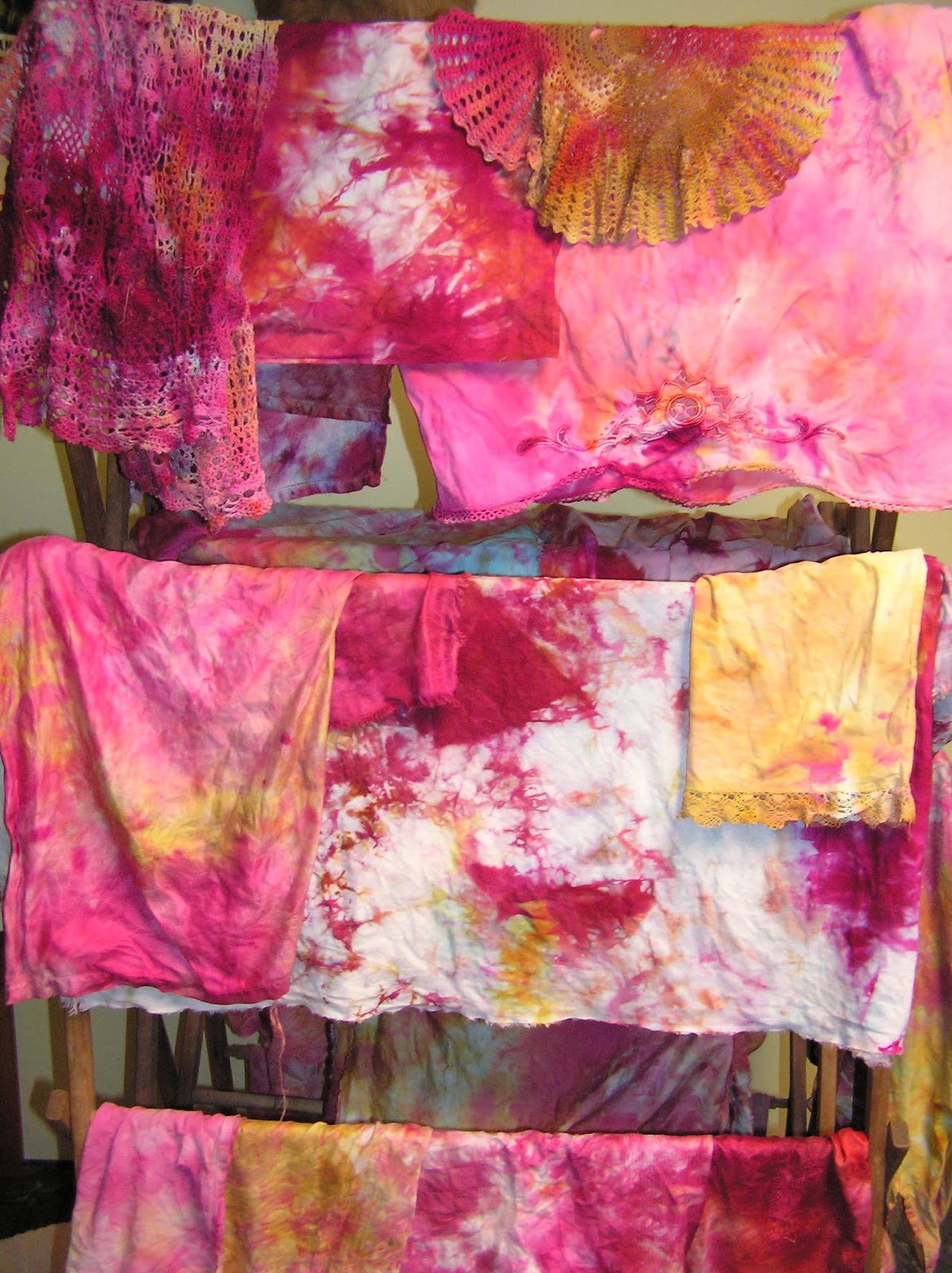
comment, “Oh, you tie dye T-shirts.” No, I do not. The following picture shows an assortment of repurposed vintage damask table linens and doilies that I snow dyed last winter with a four color blend.
I recently made the decision to phase out my small stash of
commercially printed fabrics for a number of reasons. One, if I am to earn a living off of my own
dyed fabrics, I should use what I make.
Another reason, the commercial print designs, nice as many of them are,
are someone else’s design. I have lost
interest in incorporating someone else’s work in mine; I know that is expected
with commercial fabric, it is just not me anymore. I enjoy creating my own colors and patterns
through dyeing fabric, plain and simple.
I still use solid colors of fabrics not readily available for me to dye,
and I use a fair amount of cast off clothing to add texture and pattern I
cannot achieve through my own dyed wares.
The most succinct way I can think of to describe my craft is
“art cloth.” Much of my fabric gets dyed
in solid colors, but I also make a fair amount of blends, using two to four
colors in one dye bath. The colors do
not get added all at once. The fabric
might get scrunched, folded, and rearranged with each color addition. I sometimes use ice or snow in my dye process
to achieve stunning effects with color blending. Then there is my own special “end-of-the-day”
technique that uses all of the colors that I’ve mixed for a dye session –
anywhere from 15 to 25 in one large piece of fabric.
There are many more dye techniques I haven’t
tried yet, not to mention further surface design by painting, stamping, screen
printing, etc.
Now back to that tie-dye thing. There are some wonderful surface pattern
effects that result from tying fabric in certain ways – shibori, for example,
and vastly different from what the psychedelic crowd did to t-shirts. Fabric dyeing is not solely 1960s era
t-shirts. I do not sell t-shirts at the
county fairs or Grateful Dead concerts.
Thursday, July 9, 2015
Quilt National Thoughts
At a recent Studio Art Quilt Associates Ohio meeting, I was
requested to give my thoughts on the symposium at the Quilt National opening in
late May (held at the Dairy Barn Arts Center in Athens, Ohio). At long last, here are those thoughts. Please keep in mind that this is my take on
the events of the day, and my recollections have gotten a little fuzzy in the
weeks since the symposium.
To me, it sounded like the most important criteria that the
jurors were asking themselves was: do they want to come back to the quilt and
look more at it? They were looking for
quilts that hold a viewer’s attention, ones that they would want to revisit
more than once. I imagine that the revisit
factor could come about by different means – how did the artist do something
(technique) or a message the artist wanted to convey.
Another important juror factor was connecting the artist’s
statement about the work to the work itself.
I thought that the jurors were looking at images without any
accompanying information or identification, so this was intriguing to me. Personally, I don’t go for art of any media
that has to be explained to me.
There was an active discussion about the size of works accepted
to Quilt National. The jurors
acknowledge that there were small art quilts that were “little gems,” but for
the venue of the show, they wanted works that took advantage of the spacious
exhibit hall. To me, that still wasn’t a
good reason why small works were consistently absent from Quilt National. Good art is good art, regardless of
size. So, what I took from that
discussion was at least at Quilt National, size matters!
Marvin Fletcher lecture – I skipped his talk, I wanted to
spend more time looking at the show.
Selected Artists’ Panel – Four artists discussed their work
and thoughts on their process, to some extent.
It was sort of interesting to hear their thoughts, but I didn’t really
get anything out of the lectures. I
didn’t take any notes during the panel.
I feel like I should ask myself what I would want to get out of an
artists’ panel discussion, or out of the symposium as a whole.
My overall thoughts on Quilt National:
Innovation is always claimed as a crucial criteria of
acceptance into Quilt National, after viewing this edition of the show, I am
wondering if the art quilt world has reached a plateau on innovation. In my opinion, there were thirteen quilts out
of eighty-four that were strongly influenced by the same artist/instructor. Is that innovation? Yes, those thirteen quilts had strong design
merit, but the overall similarity left me a bit befuddled. This was only my second Quilt National, and I
noticed a couple repeat artists that had very similar works in the show in 2013
and this year. I would expect any
individual artist to continually grow and evolve, not stagnate. There is a difference between having a
distinct, identifiable style and essentially repeating oneself over and over. Yes, the jurors are different each edition of
Quilt National. My point is that some
things are no longer innovative. There
were other repeat entrants that clearly evolved from two years ago, just enough
that it took a while to make the connection between their previous Quilt National
entry and this year’s entry. That’s what
I like to see.
I’m certainly not disappointed that I went. I most enjoyed the camaraderie with art
quilters from around the world, most of whom I did not know. It was refreshing to not have to explain or
defend my chosen art medium. I left the
symposium feeling that I am on the right track with the things I am making, and
I feel like I could hold my own at this level in a short time as I get better
with technique.
Friday, June 5, 2015
Spring plant dye: Horsetail
Now that spring is well underway, I have a steadily increasing
amount of different plants to try as dyes.
There is a shallow ditch running along the road frontage of my family’s
acreage that is filling in with horsetails.
By horsetails, I ‘m not talking about the last part of Secretariat to
cross the finish line, these horsetails are Equisetum
arvense, a bright green, stiff, spindly, primitive plant. The Equisetums are fascinating plants, “closely
allied to the prehistoric order of the Calamitales, large and abundant treelike
plants of the Carboniferous period nearly three hundred million years ago.” (Boughton Cobb, A Field Guide to Ferns and
their Related Families, Houghton Mifflin, 1963, p. 194) Horsetails may be used for dyeing, here is
the result:
A nice light tint of yellow green on the cottons, a bit
darker on the silk. I added a bit of
alkaline modifier in the form of wood ash solution to one pot, and it seemed to
lighten the color. I’ve given up on
weighing and measuring like most of my sources suggest. Rough visual estimates are working fine for
me, and if a batch of fabric doesn’t turn out, I’ll just try it again with a
new dyebath.
I’ve always had a deep appreciation for the natural world, I
spent summers as a youngster tagging along with my mother to her job at a
natural history museum. Now that I am
living on rural acreage, I am reacquainting myself with the wild flora and
fauna. While I was harvesting horsetails
for dyeing, I was reminded of Albrecht Durer’s Great Piece of Turf watercolor from 1503. The longer I concentrated on a square
foot of meadow edge, I found more and more different plants. Tip of the day: Never completely strip an
area of a plant you are collecting, only take a fraction of what is there, and
collect only if there is an abundance of what you seek. Of course, don’t trespass either!
Subscribe to:
Posts (Atom)